Infrared Sauna Electrical Requirements: Plugs, Amps & Wiring
Before you buy, check one thing: what will the sauna plug into. Most 1-2 person infrared saunas run on a standard 120V household outlet, but larger and full-spectrum cabins often need a dedicated circuit that an electrician installs. Here is exactly how to read the spec, size the circuit, and avoid the two mistakes that cause trouble: shared circuits and extension cords.
Most 1-2 person infrared saunas plug into a standard 120V 15A outlet and need no special wiring. They draw roughly 1,500 to 1,800 watts. Larger 3-4 person and full-spectrum units often require a dedicated 120V 20A circuit or a 240V circuit installed by a licensed electrician. Never run a sauna on an extension cord.
Requirements vary by model. Always follow the manufacturer manual and your local electrical code, and hire a licensed electrician for any new circuit.
What Most Infrared Saunas Need, By Size
The single biggest factor is size. A one or two person cabin has one or two banks of far infrared panels and draws about the same as a space heater. A three or four person cabin, and especially a full-spectrum unit that adds near and mid infrared heaters, draws more and pushes past what a shared 15A circuit should carry. The table below is a general guide. Your specific unit may differ, so treat the spec plate and manual as the final word.
| Sauna size | Voltage | Typical amps | Plug / outlet | Dedicated circuit |
|---|---|---|---|---|
1-person | 120V | 13-15A | Standard 3-prong (NEMA 5-15) | Recommended, not required |
2-person | 120V | 15A | Standard 3-prong (NEMA 5-15) | Recommended |
3-4 person | 120V or 240V | 20A (120V) or 20-30A (240V) | NEMA 5-20 or 240V outlet | Yes, dedicated circuit |
Full-spectrum | 120V 20A or 240V | 20-30A | NEMA 5-20 or 240V outlet | Yes, dedicated circuit |
NEMA 5-15 is the standard three-prong outlet in most homes. NEMA 5-20 is the 20A version, which has one horizontal slot. A 240V outlet is a different receptacle entirely and requires a dedicated circuit.
Why a Sauna Is a Continuous Load: The NEC 80 Percent Rule
The reason manufacturers push dedicated circuits is not the amount of power, it is the duration. An infrared sauna runs at near-full draw for the entire session, often 30 to 45 minutes. Under the National Electrical Code, any load that runs for three hours or more is treated as a continuous load, and a sauna session plus preheat sits right at that boundary in practice. The NEC continuous-load rule says a circuit should be loaded to no more than 80 percent of its breaker rating when the load runs continuously.
Run the math and it explains the whole guidance. A 15A 120V circuit can carry 1,800 watts at its rating, but under the 80 percent rule its safe continuous ceiling is about 1,440 watts. A sauna that draws 1,500 to 1,800 watts is already at or above that ceiling. That is why a small sauna technically fits a 15A outlet but is happier on its own circuit, and why anything larger needs a 20A or 240V circuit with more headroom.
This also feeds directly into what a session costs to run, since watts drawn over time is exactly what your meter bills. We break that down in the infrared sauna electricity cost guide, and the purchase-plus-installation picture in the full infrared sauna cost breakdown.
When and Why a Dedicated Circuit Matters
A dedicated circuit is a breaker and wire run that serves only the sauna, with nothing else on it. It matters for two reasons. First, headroom: with the sauna alone on the circuit, you are not stacking its 1,500-plus watt continuous draw on top of a microwave, a hair dryer, or a shared bathroom load that trips the breaker mid-session. Second, safety and longevity: a breaker that repeatedly runs near its limit ages faster and nuisance-trips, and a shared circuit at capacity heats the wiring more than a properly sized dedicated run.
For a small sauna, a dedicated 120V 15A or 20A circuit is a comfortable setup. For a 3-4 person or full-spectrum cabin, a dedicated circuit is not optional, and many of those units call for 240V. A 240V circuit delivers the same power at half the current, which keeps the wire gauge and heat down for high-wattage units. Your manual will state which the unit needs; do not guess.
120V is your standard wall outlet. 240V is what an electric dryer or range uses, run on a dedicated circuit with a different receptacle. A small infrared sauna almost always uses 120V. Some large and full-spectrum units use 240V because it moves their higher wattage at lower current. You cannot convert one to the other with an adapter; the unit is built for one or the other.
GFCI, Outdoor Wiring, and Weatherproofing
A GFCI (ground-fault circuit interrupter) cuts power fast if it senses current leaking to ground, which is the protection you want anywhere moisture is possible. For an indoor infrared sauna in a dry room, a GFCI is often not code-required, but some manufacturers advise against GFCI protection because the heaters can cause nuisance trips. Others require it. This is a case where you follow the manual and your local inspector rather than a blanket rule.
Outdoor and garage saunas are a different picture. Any outlet outdoors or in a damp location generally must be GFCI protected under current code. An outdoor infrared sauna needs a weatherproof outlet with an in-use bubble cover, wiring rated for the location, and often a dedicated run from the panel to the sauna site. Do not extend an indoor circuit outside with a household cord. Have an electrician install a proper outdoor-rated circuit, and confirm the sauna cabin itself is rated for outdoor use before you place it outside.
How to Check Your Sauna's Electrical Requirement
You do not have to guess. Every unit publishes its draw. Here is how to find it and match it to your home before you buy or install.
Look for the amperage and wattage on the unit's label (often near the power cord entry) or in the specifications section of the manual. You want two numbers: volts (usually 120V or 240V) and amps or watts. If only watts are listed, divide watts by volts to get amps: 1,600W / 120V is about 13.3A.
Take the unit's watts and check it against the 80 percent continuous limit of the circuit you plan to use: about 1,440W on a 15A 120V circuit, about 1,920W on a 20A 120V circuit. If the draw is close to or above the ceiling, plan on a dedicated circuit of the right rating.
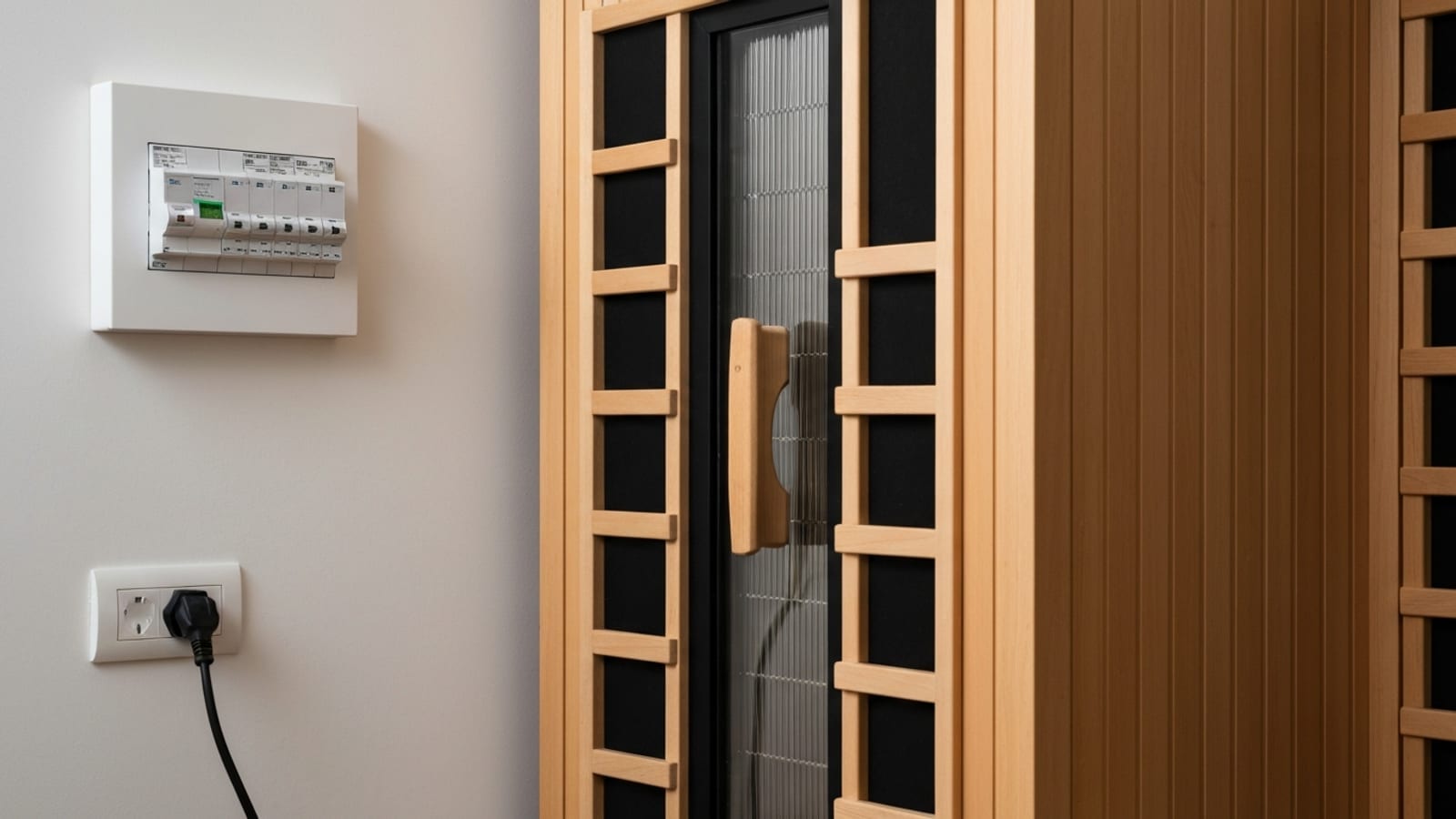
Find the outlet you intend to use, then check your breaker panel to see what else shares that circuit. If a bathroom, kitchen, or laundry load is on the same breaker, that shared circuit is a poor choice for a continuous sauna load. A dedicated circuit removes the guesswork.
A NEMA 5-15 plug fits any standard outlet. A NEMA 5-20 plug (with a horizontal blade) needs a 20A outlet. A 240V unit needs a 240V receptacle. Confirm the plug on the cord matches the outlet you have, or budget for an electrician to install the correct one.
The manufacturer manual states the required circuit, and local code governs GFCI, wire gauge, and outdoor requirements. Where the two differ, the stricter rule wins. For any new circuit, this is where a licensed electrician takes over.
Do not run an infrared sauna through an extension cord or power strip. A sauna pulls high wattage continuously, and an undersized or lengthy cord heats up, drops voltage, and becomes a fire risk. Most manufacturers void the warranty for extension cord use. If the wall outlet is too far away, the fix is an electrician-installed outlet closer to the sauna, not a cord.
What It Costs to Add a Dedicated Circuit
If your sauna needs a circuit you do not have, the cost depends on distance from the panel, whether the panel has a free breaker slot, and local labor rates. As a rough planning range, adding a dedicated 120V 20A circuit near an existing panel commonly runs about $250 to $800. A 240V circuit, or a run that crosses finished walls, a longer distance, or an outdoor route, more often lands in the $500 to $1,500 range, and can go higher if the panel needs an upgrade.
These are estimates, not quotes. Get a licensed electrician to price your exact situation. Factor this into the total when you compare units; a cheaper large sauna that needs a 240V circuit may cost more all-in than a small unit that plugs into an existing outlet. If you are building your own setup, the wiring side is covered in the DIY infrared sauna guide, and a portable infrared sauna sidesteps the circuit question entirely by running on a standard outlet.
Plugging a small sauna into an existing, appropriate outlet is a homeowner job. Everything past that is an electrician job: installing a new dedicated circuit, adding a 20A or 240V receptacle, wiring an outdoor or damp-location outlet with GFCI, or upgrading a panel that has no free slots. New circuits are permitted and inspected work in most areas. Do not improvise wiring to save a service call; the sauna\'s continuous load is exactly the kind of load that punishes shortcuts.
The Bottom Line Before You Buy
Electrical requirements should be a quick check, not a deal-breaker. For most people shopping a 1-2 person infrared sauna, the answer is simple: it plugs into a standard 120V outlet, ideally on a circuit that is not already loaded, and draws about 1,500 to 1,800 watts. Read the spec plate, confirm the outlet, and you are done.
For a 3-4 person or full-spectrum cabin, plan for a dedicated 20A or 240V circuit and budget for an electrician. Whatever the size, follow the manufacturer manual and your local electrical code, use the correct outlet rather than an extension cord, and let a licensed electrician handle any new circuit. Get those basics right and the only heat you will feel is the good kind.