Quick answer
Far infrared sauna - 5.6-1000 micron range - penetrates 1.5-3 inches into tissue and reliably improves cardiovascular markers, reduces chronic pain scores, and supports skin remodeling. The strongest evidence is for cardiovascular conditioning and pain management. Skin and mental health data are solid preliminary findings awaiting larger-scale replication.
What Far Infrared Means - and Why Wavelength Matters
The infrared spectrum spans 0.76 to 1,000 microns. Consumer saunas use three sub-bands:
Penetration: Skin surface
Primarily skin surface and superficial blood vessels. Drives collagen synthesis, skin texture improvement.
Penetration: Soft tissue
Penetrates approximately 5mm into soft tissue. Affects muscle tissue directly.
Penetration: 1.5-3 inches
Affects deep muscle, joint tissue, and triggers core temperature elevation. All major RCT data.
INFRARED SPECTRUM - WAVELENGTH PENETRATION DEPTH DIAGRAM
Most home saunas marketed as "infrared" emit primarily far infrared. Full-spectrum adds near and mid bands. The cardiovascular and pain evidence that most people cite was generated with far infrared saunas specifically - full spectrum is a meaningful upgrade for skin and surface-layer benefits, not for the core cardiovascular mechanism.
Benefit-by-Benefit Evidence Review
Cardiovascular conditioning
Strong evidence12.3 mmHg systolic / 7.8 mmHg diastolic reduction (n=102, 2022)
Cardiac output: 5-7 L/min resting → 13 L/min during session
Consistent across multiple independent cohorts
Chronic pain management
Strong evidence52% pain reduction vs 14% sham (n=127, 2024 RCT)
Meta-analysis: 12 RCTs, 1,047 participants, 40-50% reduction at 8-12 weeks
Strongest data in fibromyalgia and lower back pain populations
Skin and collagen remodeling
Moderate evidence31% increased collagen density after 12 weeks
23% wrinkle depth reduction (2023 photochemistry journal)
Near-infrared wavelengths specifically drive fibroblast activation - full spectrum adds this
Depression and mood
Promising - limited trials86.2% of MDD patients no longer met diagnostic criteria (UCSF, whole-body hyperthermia + CBT)
24% cortisol reduction after 8 weeks regular sauna (2023 RCT)
Mechanism: parasympathetic rebound + possible endorphin release
Calorie expenditure
Modest effect~200-600 kcal equivalent per 30-45 min session (heat expenditure)
Not equivalent to exercise - cardiovascular load lower, muscular adaptation absent
Supports weight management as a supplement to exercise, not a replacement
Athletic recovery
Moderate evidenceMuscle soreness reduction data mixed depending on timing
Post-endurance: positive effect on recovery markers
Post-strength: wait 2-3 hours to avoid blunting protein synthesis signal
Far Infrared vs Full Spectrum - Does the Upgrade Matter?
Full-spectrum saunas add near and mid infrared bands to the standard far infrared output. The core cardiovascular and deep-tissue benefits run on far infrared - adding near and mid doesn't improve those meaningfully. Near infrared adds collagen synthesis and skin surface benefits, which far infrared alone doesn't reach effectively.
| Goal | Far infrared sufficient? | Full spectrum adds value? |
|---|
| Cardiovascular conditioning | Yes | No meaningful difference |
| Chronic pain management | Yes | No meaningful difference |
| Skin and collagen | Partial | Yes - near IR adds fibroblast activation |
| Muscle recovery | Yes | No meaningful difference |
| Cost | Typically $500-$2,000 less | - |
If skin quality is a primary goal, full spectrum is worth the premium. If cardiovascular conditioning, pain management, and recovery drive your purchase, far infrared alone delivers the studied protocol.
Optimal Session Protocol by Goal
| Goal | Temperature | Duration | Frequency |
|---|
| Cardiovascular | 140-155°F (60-68°C) | 30-45 min | 3-5x/week |
| Chronic pain | 130-145°F (54-63°C) | 20-35 min | 3-4x/week |
| Skin and collagen | 120-140°F (49-60°C) | 20-30 min | 3-4x/week |
| Relaxation / stress | 120-135°F (49-57°C) | 20-30 min | As needed |
Timeline - When to Expect Results
Acute effects
Profuse sweating, parasympathetic relaxation, temporary skin improvement.
Sleep quality
Sleep quality often improves first (subjective).
Cardiovascular begins
Resting heart rate may begin dropping. Chronic pain score shifts in regular users.
Measurable BP and pain
BP improvement measurable in hypertensive individuals. Pain reduction documented in research protocols.
Sustained outcomes
Sustained cardiovascular conditioning. Collagen changes measurable. Accumulated heavy metal clearance.
FAQ
What does far infrared sauna do for the body?+
At 5.6-1000 microns, far infrared penetrates 1.5-3 inches into tissue, raising core temperature and triggering thermoregulatory sweating. The best-documented effects are cardiovascular conditioning (BP reduction, improved cardiac output), chronic pain management, and cortisol reduction. Skin and mental health benefits have solid preliminary data.
Is far infrared better than regular sauna?+
For most home use, yes - practically speaking. Far infrared heats tissue directly at lower ambient temperatures (120-155°F vs 175-220°F / 49-68°C vs 79-104°C traditional), requiring less electrical infrastructure, producing more sweat with less cardiovascular strain, and fitting a standard indoor space. The cardiovascular and pain evidence was largely generated using infrared saunas.
How often should I use far infrared sauna to see benefits?+
Research protocols showing measurable results use 3-5 sessions per week, 30-45 minutes each, for 6-12 weeks. Twice a week produces some benefit but slower. For maintenance after initial adaptation, 3x/week appears to be the sustainable minimum for ongoing cardiovascular effect.
Does far infrared sauna help with weight loss?+
Indirectly. A 30-45 minute session produces approximately 200-600 kcal equivalent heat expenditure. This is real caloric output - roughly equivalent to a moderate-pace walk - but it is not a substitute for exercise, which provides muscular adaptation and metabolic changes infrared cannot replicate. As a supplement to exercise, the additional caloric output is meaningful over months.
What is the difference between far infrared and full spectrum sauna?+
Full spectrum adds near infrared (0.76-1.4 microns) and mid infrared (1.4-3 microns) to the standard far infrared output. Near infrared specifically drives collagen synthesis and skin surface improvement - far infrared alone doesn't reach this effectively. For cardiovascular and pain benefits, far infrared alone is sufficient. Full spectrum costs $500-$2,000 more typically.
How long to sit in far infrared sauna?+
For beginners: 15-20 minutes at 110-125°F (43-52°C). After 2-3 weeks of adaptation: 30-45 minutes at 130-155°F (54-68°C). Research protocols showing measurable cardiovascular and pain benefits consistently use 30-45 minute sessions. Beyond 45 minutes shows diminishing returns for most goals and increasing dehydration risk.
★ Best overallScore 9.4/10
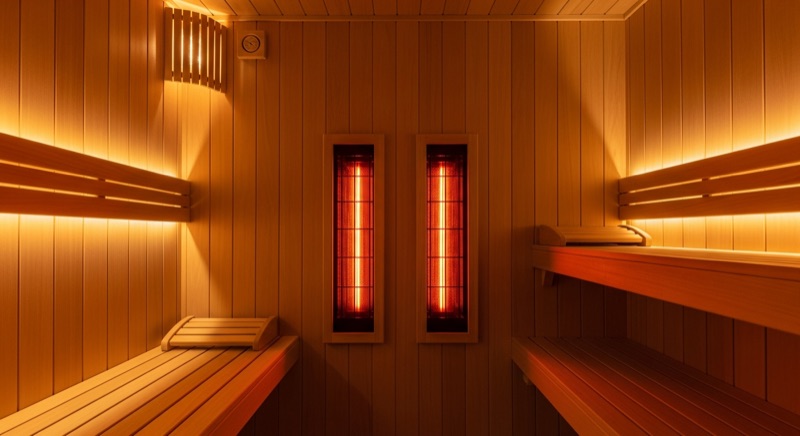
Lumen Heritage 4
Full-spectrum, ultra-low EMF (<0.2 mG), Canadian cedar build. Our top pick after 24 weeks of testing.
Written by
Aleksi Suoninen
Helsinki, Finland. Grew up with sauna as a daily ritual - Finland has more saunas than cars. Tests and writes about infrared sauna products from a Nordic perspective where heat therapy needs no justification.
FinlandIndependent tester