INFRARED CABIN · STEAM ROOM SIDE BY SIDE
Quick answer
Quick answer
An infrared sauna uses dry radiant heat at 120-150°F (49-66°C) that passes through the air and penetrates 1.5-3 inches (4-8 cm) into tissue. A steam sauna, more precisely a steam room, holds 95-100% humidity at 110-120°F (43-49°C), and that wet heat acts on the skin surface and the airways instead of deep tissue. That one difference drives everything else. Infrared sessions run 30-45 minutes in dry air and suit deep muscle work, stiff joints, and sustained cardiovascular load. Steam sessions run 10-20 minutes because saturated air blocks evaporative cooling, and they suit congestion, sinus pressure, and skin hydration. Infrared also costs less to install ($1,500-$8,000 against $2,000-$10,000+), less to run ($8-$20 a month against $18-$45), and needs no drain, no waterproof membrane, and no mold routine.
Short version: if you want one heat box at home for recovery, pain, and heart health, buy infrared. If you want warm wet air for your lungs and skin, and you already have a tiled space with a floor drain, build steam.
At-a-glance comparison
Fifteen specs across all three heat types, from temperature to mold risk to lifespan. The dry sauna column is included because "infrared vs dry sauna" is a common search, and there is a dedicated section on it below.
| Infrared sauna | Steam room / sauna | Dry sauna (Finnish) |
|---|
| Air temperature | 120-150°F (49-66°C) | 110-120°F (43-49°C) | 180-220°F (82-104°C) |
| Humidity | 10-20% | 95-100% | 10-20% |
| How it heats the body | Radiant IR waves, 1.5-3 in (4-8 cm) tissue penetration | Hot humid air, surface heating only | Convection air + kiuas stones |
| Session length | 30-45 min | 10-20 min | 10-20 min |
| Heat-up time | 10-20 min | 15-30 min | 30-60 min (stones must saturate) |
| Sweat character | Heavy, free-running sweat that still evaporates | Skin stays soaked, condensation masks true sweat volume | Fast onset, evaporates almost instantly |
| Respiratory effect | Neutral - dry air, no mucus effect | Strong - warm moist air thins mucus, eases sinus pressure | Drying - can irritate airways without loyly |
| Cardiovascular load | HR 100-140 bpm sustained across a long session | HR climbs fast, session ends before load accumulates | Highest peak HR, shortest tolerable time |
| Perceived intensity | Tolerable at full temp | Heavy, suffocating at high humidity | Most intense, challenging for beginners |
| Install requirements | Level floor + dedicated 15-20A circuit (240V on larger units) | Generator, 240V circuit, plumbed water line, floor drain, waterproof membrane, vapour-tight door | Heater circuit, fire-rated build, intake and exhaust ventilation |
| Space requirements | 4×4 ft minimum | Requires waterproofing + drain | 5×7 ft minimum, ventilation required |
| Home install cost | $1,500-$8,000 | $2,000-$10,000+ | $3,000-$12,000+ |
| Running cost / month | $8-$20 | $18-$45 | $10-$30 |
| Maintenance / mold risk | Very low - wipe benches, inspect heaters every few years | High - descale the generator, scrub grout, run the fan after every use or mold follows | Low - sweep, replace stones every 3-5 years |
| Typical lifespan | 15-25 years | 10-15 years, generator at 8-12 | 20-30 years, heater at 10-15 |
Steam room vs steam sauna vs steam shower
People search for "steam sauna", "steam room", and "steam shower" as if they were one product. They are three different builds with different temperatures, different price tags, and different failure modes, and picking the wrong one is the most common mistake we see in this comparison.
A steam room is the commercial article: a fully tiled, vapour-sealed room with sloped ceilings and a floor drain, fed by a plumbed generator, held at 95-100% humidity and about 110-115°F (43-46°C). That is what you use at a gym or hotel spa. A steam shower is the home version, a normal shower enclosure with a sealed door and a smaller generator, and it usually sits a few degrees cooler because the enclosure is smaller and loses heat faster. A steam sauna is a loose term: sometimes it means a steam room, and sometimes it means a traditional Finnish sauna where water is thrown on hot stones to make loyly, which is a completely different environment at 180-200°F with humidity that spikes to 40-60% and then falls back. An infrared sauna is none of these. It never produces steam at all.
| Type | What it actually is | Temp / humidity | Best at |
|---|
| Steam room | Tiled, vapour-sealed room with a floor drain and a plumbed generator. The commercial gym and spa format. | 110-115°F / 100% | Congestion, sinuses, skin hydration, long social sessions |
| Steam shower | A sealed home shower enclosure with a compact generator. The realistic home version of a steam room. | 105-115°F / 100% | Same benefits in a bathroom footprint, at a fraction of the build cost |
| Traditional sauna | Wood-lined room with a stone-topped heater. Water on the stones makes short bursts of loyly steam. | 180-200°F / 10-20%, spiking to 60% | Intensity, ritual, the highest peak heart rate of the four |
| Infrared sauna | Wood cabin with radiant emitters. No water, no steam, no plumbing, no drain. | 120-150°F / 10-20% | Deep muscle and joint heat, long tolerable sessions, low running cost |
The practical consequence: if the wet-heat experience you remember is from a gym, you are remembering a steam room, and the home equivalent you should be pricing is a steam shower, not a prefab sauna. If what you remember is a hot wooden room that made you gasp, that was a traditional sauna, and the right comparison for you is our infrared vs traditional sauna guide or the drier framing in infrared vs dry sauna. Infrared is the only one of the four that asks nothing of your plumbing.
How each type works
Infrared sauna
Infrared sauna heaters emit near, mid, or far infrared wavelengths (or all three in full-spectrum units). These waves pass through cabin air largely unabsorbed and interact directly with body tissue. Far-IR wavelengths around 9-10 micrometers match human tissue resonance frequencies, which is why penetration reaches 1.5-3 inches (4-8 cm) below the skin. The body temperature rises without needing the air itself to be extremely hot.
Air temperature sits at 120-150°F (49-66°C) - hot, but not the 180-220°F (82-104°C) of a traditional Finnish dry sauna. Because the air is dry (10-20% relative humidity) and cooler than a dry sauna, most people find they can tolerate a full 30-45 minute session comfortably. Core body temperature rises to 38.5-39.5°C during a standard session.
DIAGRAM · INFRARED WAVE PENETRATION DEPTH
Steam room / steam sauna
A steam generator heats water to produce continuous wet steam, raising relative humidity to 95-100%. Air temperature stays lower than a dry sauna - typically 110-120°F (43-49°C) - but the dense humid air transfers heat to the body extremely efficiently. Because evaporative cooling (sweat) barely works in 95-100% humidity, the body heats quickly and sessions are kept short: 10-20 minutes is standard.
Heat transfer in a steam environment is surface-level. The warmth does not penetrate tissue the way infrared waves do. The benefit comes from thermal stress at the skin and via circulatory response - peripheral vasodilation and increased cardiac output - the same underlying mechanism as infrared, just via a different delivery route.
Which is better for your goal
"Which is better" has no answer in the abstract. It has a clear answer once you name the outcome you are buying for. Here is how the two split, goal by goal, with the honest strength of the evidence attached.
Congestion, sinuses, and airways
Steam
Warm saturated air raises the temperature and water content of the airway lining, thins mucus, and makes it easier to clear. This is the one area where steam is not just different but better. Expect symptom relief, not a shorter cold. The exception is asthma: dense humid air provokes symptoms in a meaningful minority, and those people do better in dry infrared heat.
Deep muscle soreness and joint pain
Infrared
Infrared is the only one of the two that delivers heat below the skin, roughly 1.5-3 inches in, which is where a stiff shoulder capsule or a sore quadriceps sits. Steam warms the surface and relies on blood flow to carry that heat inward, which works but is slower and shallower. Trials on infrared for chronic pain and rheumatoid conditions report reduced pain and stiffness scores over 4-8 week programs.
Skin: hydration now vs texture later
Split
Steam raises the water content of the outer skin layer, so you leave looking plumper and softer, and that effect fades within hours. Infrared works over months by increasing dermal blood flow, with small trials on near-infrared reporting collagen and texture changes at 8-12 weeks. Steam can also flare rosacea and feed fungal acne. More detail in our guide to the infrared sauna for skin. infrared sauna for skin.
Sleep and stress
Infrared, narrowly
Both work through the same route: a passive core temperature rise, then a sharper drop 60-90 minutes later that helps sleep onset, plus a parasympathetic rebound after the session. Infrared wins on practicality rather than physiology, because a 35-minute session at 140°F is something most people will actually do at 8pm, while 15 minutes at 100% humidity is not everyone’s idea of winding down.
Cardiovascular adaptation
Infrared
Heat therapy improves blood pressure and endothelial function by repeatedly loading the circulation, and the load is a product of intensity and time. Infrared sustains a heart rate of 100-140 bpm across 30-45 minutes. Steam pushes heart rate up faster but the session ends at 15 minutes because the air is intolerable, so total load is lower. Infrared also has far more published trial data at home-usable temperatures.
Sweat volume and the detox claim
Infrared on volume, neither on detox
Infrared produces more measured sweat over a full session simply because the session is longer. In a steam room you cannot tell: the condensation on your skin is the room, not you. Neither modality removes a clinically meaningful toxin burden. Sweat is water and electrolytes with trace metals at analytical detection limits, and your liver and kidneys are doing the real work.
Choose infrared if...
- →Your goal is deep muscle, joint, or back pain relief
- →You want sustained cardiovascular load, not a short spike
- →You have asthma or find humid air hard to breathe
- →You want to sit for 35-45 minutes and read or listen to something
- →You are working on skin texture over months, not glow over hours
Choose a steam room if...
- →You get seasonal sinus pressure or chronic congestion
- →You want skin that feels hydrated the same afternoon
- →You prefer a short, intense 15-minute session
- →Wet heat is the experience you are actually paying for
- →Dry heat leaves your throat and eyes irritated
Health benefits
Evidence ratings below reflect the quality of available human RCT data, not social media consensus.
Cardiovascular markers (BP, endothelial function)
Consistent improvement in multiple RCTs. Effect size d ~0.6, most pronounced with 3-5 sessions per week over 8+ weeks.
Evidence: Strong - multiple RCTs
Muscle recovery / DOMS reduction
Moderate evidence for reduced delayed-onset soreness. Easier to complete a full session post-workout due to lower air temp.
Evidence: Moderate - limited RCTs
Skin hydration and texture
Steam room has the edge here - high humidity actively increases skin moisture during and shortly after sessions.
Evidence: Moderate (steam) / Weak (infrared)
Respiratory benefit / decongestion
Steam clearly outperforms. Warm humid air opens airways and loosens mucus. Infrared has no humidity benefit.
Evidence: Moderate (steam) / Not applicable (infrared)
Sweat volume and electrolyte loss
Infrared typically produces higher sweat volume over a 30-minute session than a 15-minute steam session. Neither removes toxins beyond trace amounts.
Evidence: Consistent observation, limited clinical significance
Sleep quality
Parasympathetic rebound 90 min after a session associates with improved sleep onset. Applies to both types. More data on infrared.
Evidence: Emerging - small trials
Detox and sweat: Both types produce sweat. Sweat is 99% water and electrolytes, with trace heavy metals measurable at analytical detection limits. No peer-reviewed trial has demonstrated that either sauna type removes a clinically significant burden of environmental toxins that the liver and kidneys would not otherwise process. The legitimate benefit of both is the cardiovascular and autonomic adaptation from repeated controlled heat exposure, not the chemistry of sweat.
Installation and cost
Infrared sauna
- -Prefab 2-person unit: $1,500-$3,500
- -Quality 2-person unit: $2,500-$5,500
- -Premium / 4-person: $5,000-$8,000
- -Power: 120V or 240V depending on model
- -No plumbing required
- -No waterproofing required
- -Install time: 2-4 hours self-assembly
- -Running cost: $8-$20 per month at avg use
Steam room
- -Prefab kit: $2,000-$5,000
- -Custom tiled steam room: $5,000-$10,000+
- -Generator replacement at 8-12 years
- -Requires 240V dedicated circuit
- -Requires floor drain and waterproofing membrane
- -Grout / tile maintenance ongoing
- -Install time: 2-5 days (professional recommended)
- -Running cost: $18-$45 per month at avg use
The steam room's waterproofing and drainage requirement is the largest hidden cost. A leaking membrane can destroy subfloor material. Professional installation is strongly recommended for steam. Most infrared prefab units can be assembled without a contractor.
Infrared vs dry sauna - the three-way view
A traditional Finnish dry sauna (also called a rock sauna or kiuas sauna) operates at 180-220°F (82-104°C) with 10-20% humidity - hot, dry air that heats the body primarily by convection. Stones on the kiuas absorb heat and can be dosed with water (loyly) to produce bursts of steam, briefly spiking humidity to 40-60%.
Against infrared, dry sauna offers a more intense, traditional experience but requires longer heat-up times (30-60 minutes for stones to fully saturate), higher installation cost, mandatory ventilation, and a learning curve for new users who find 200°F (93°C) air difficult to tolerate.
Three-way summary
Infrared
Easiest to install, most accessible, consistent science support, dry and moderate temp. Best default for most homes.
Steam
Best for respiratory benefit and skin hydration. Higher install complexity and cost. Superior humid-heat experience.
Dry (Finnish)
Highest intensity, most traditional. Requires most space, longest heat-up, ventilation. Deepest loyly culture.
Who should choose which
Choose infrared if...
- →You want the lowest installation barrier and cost
- →You prefer dry heat and find high humidity uncomfortable
- →Recovery from training is a primary goal
- →You have limited space - 4x4 ft minimum vs steam room footprint
- →You want to use it daily at low running cost
- →Cardiovascular adaptation and HSP expression are your target
- →You are new to heat therapy and want to ease in
Choose steam if...
- →You have chronic sinus issues or upper respiratory congestion
- →You want a social wet-heat experience
- →Skin hydration and soft tissue warmth are priorities
- →You already have appropriate waterproofing in the planned space
- →You prefer shorter, more intense sessions over longer gentle ones
- →You enjoy the dense, enveloping feeling of wet heat
- →You are building a custom spa-like bathroom with a drain
Verdict
Verdict
For most home buyers comparing infrared sauna vs steam sauna, infrared is the clearer choice. It costs less to build, less to run, tolerates a wider range of installation conditions (no drain, no waterproofing, smaller footprint), and produces the cardiovascular and recovery benefits that most people are seeking. Steam is not inferior - it is a different tool that excels for respiratory benefit and the wet-heat experience. If you already have a tiled bathroom with a drain and value high humidity above all else, steam is the right call. For everyone else, infrared is the more practical, durable, and lower-maintenance option.
★ Best overallScore 9.4/10
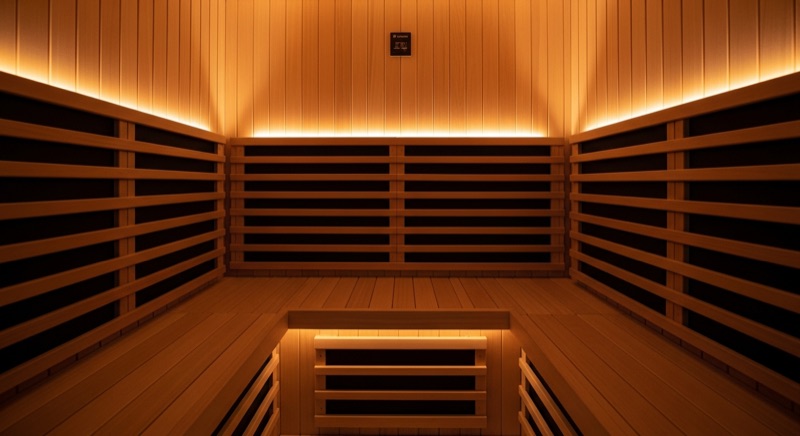
Lumen Heritage 4
Full-spectrum, ultra-low EMF (<0.2 mG), Canadian cedar build. Our top pick after 24 weeks of testing.
Frequently asked
What is the difference between an infrared sauna and a steam room?+
An infrared sauna is a dry wooden cabin where emitters produce radiant heat at 120-150°F (49-66°C) and 10-20% humidity, and that radiation warms your body directly to a depth of roughly 1.5-3 inches (4-8 cm). A steam room is a sealed tiled room fed by a steam generator, held at 95-100% humidity and 110-120°F (43-49°C), where the heat stops at the skin and the airways. Infrared sessions run 30-45 minutes and suit deep muscle work, joint stiffness, and cardiovascular training. Steam room sessions run 10-20 minutes and suit congestion, sinus pressure, and skin hydration. Practically: the infrared cabin plugs in and needs no plumbing, while the steam room needs a generator, a water line, a floor drain, a waterproof membrane, and constant mold control.
Which is better for congestion, steam or infrared?+
Steam, clearly. Warm saturated air raises the temperature and moisture content of the airway lining, thins mucus, and makes it easier to clear, which is why steam inhalation has been a standard home measure for colds and sinus pressure for a century. Trials show symptomatic relief rather than a shorter illness, so treat it as comfort rather than cure. Infrared adds no humidity, so it does nothing directly for a blocked nose - any relief is indirect, from general vasodilation. If congestion is the main reason you are buying, a steam room, or even a steam head in an existing shower, beats an infrared cabin. People with asthma are the exception: dense humid air provokes symptoms in some, and dry infrared heat is usually easier to tolerate.
Is a steam room or infrared sauna better for your skin?+
Steam wins on immediate hydration. Saturated air raises the water content of the stratum corneum, so skin looks plumper and feels softer for several hours after a session. Infrared works on a different timeline: deep heat increases dermal blood flow, and small trials on near-infrared and red wavelengths report gradual changes in collagen density and skin texture over 8-12 weeks of repeated exposure. Steam has real downsides for some faces, though. Heat plus humidity can flare rosacea and feed fungal acne, and a steam room with tired grout is a mold reservoir sitting against your skin. Short-term glow: steam. A longer program aimed at texture and firmness: infrared.
Which burns more calories - infrared or steam sauna?+
Both produce a cardiac output increase that raises calorie burn above resting baseline. Research estimates 150-300 kcal per 30-minute infrared session and roughly 100-200 kcal per 15-minute steam session at high intensity. Neither figure is precise enough to plan weight loss around - the calorie math disappears when you rehydrate. The more durable benefit is the cardiovascular adaptation that regular heat exposure builds over months.
Is infrared sauna better for detox than steam?+
Both produce sweat. Sweat is mostly water and electrolytes, with trace amounts of heavy metals measurable in high-volume sessions. No peer-reviewed study has demonstrated that either modality removes a clinically significant quantity of toxins that the liver and kidneys do not handle. The "detox" framing is marketing shorthand for the real benefit: cardiovascular and autonomic nervous system adaptation from repeated controlled heat stress.
Can you use an infrared sauna if you have respiratory issues?+
For most people with mild asthma or upper respiratory sensitivity, infrared is more comfortable than steam or dry because the air stays dry and at a tolerable temperature. Steam rooms can trigger difficulty breathing for some asthma sufferers due to the dense humid air. Always consult your physician before starting heat therapy if you have a diagnosed respiratory condition.
What is the difference between a steam room and a steam sauna?+
"Steam room" and "steam sauna" are used interchangeably in most consumer contexts. Technically a steam room uses a generator to produce wet steam at 95-100% humidity and 110-120°F (43-49°C), while a traditional "steam sauna" can refer to any sauna where water is poured on heated rocks to generate bursts of steam - a practice called loyly. Both produce high-humidity environments. Infrared saunas produce neither.
Which is better for muscle recovery - infrared or dry sauna?+
Both show benefit in the recovery literature. Infrared has more RCT data on delayed-onset muscle soreness specifically, likely because it is easier to standardize in a lab at home temperatures. Dry sauna at 176°F (80°C) for 30 minutes post-exercise shows significant improvement in plasma growth hormone and HSP70 expression. The practical advantage of infrared is the lower air temperature makes it easier to complete a full session after an intense workout.
How long do infrared saunas last compared to steam rooms?+
A quality infrared sauna cabinet made from Canadian hemlock or cedar should last 15-25 years with basic maintenance - occasional cleaning and heater inspection every few years. Steam rooms require more vigilance: the tile grout, waterproof membrane, and steam generator are all failure points. A well-built steam room lasts 10-15 years before the first major refurbishment. Generators typically need replacement at 8-12 years.
Can you build a dry sauna at home for less than infrared?+
Rarely. A prefab dry sauna kit from a reputable brand starts at $3,000 and requires proper ventilation, a GFCI-protected 240V circuit, and at minimum a fire-rated floor. A quality 2-person infrared unit starts at $1,500 and runs on a standard 20A, 120V outlet in most markets. Custom dry saunas with kiuas stones and the full Finnish build are expensive - $8,000-$15,000 installed. For budget-first buyers, infrared is almost always the lower barrier to entry.
Written by
Aleksi Suoninen
Helsinki, Finland. Grew up with sauna as a daily ritual - Finland has more saunas than cars. Tests and writes about infrared sauna products from a Nordic perspective where heat therapy needs no justification.
FinlandIndependent tester
Every unit ran daily sessions in a controlled 22°C ambient room in Helsinki. We logged EMF at three positions (panel face, mid-cabin, and seated body position), heat-up curves, surface temperature uniformity, and energy draw on calibrated meters.