Infrared Sauna vs Hot Tub: Cost, Recovery, and Which to Buy
Both are heat-based wellness machines, but they solve different problems and cost wildly different amounts to own. One warms you with dry radiant heat and sips electricity. The other holds a few hundred gallons of water hot every hour of every day. Here is how an infrared sauna and a hot tub actually compare on the things that matter: cost, recovery, maintenance, space, and sleep.
Buy an infrared sauna if you want the strongest heat therapy and cardiovascular dose for the least running cost, and you have indoor space. Buy a hot tub if you want social soaking, buoyant joint relief, and a warm wind-down ritual, and you can accept 40 to 90 dollars a month to keep it running. For pure recovery per dollar, the sauna wins. For relaxation and shared time in the water, the hot tub wins.
Infrared Sauna vs Hot Tub at a Glance
The clearest way to see the split is side by side. Numbers below reflect typical home units, not the extremes at either end of the market.
| Dimension | Infrared Sauna | Hot Tub |
|---|---|---|
| Heat type | Dry radiant heat, warms your body directly | Hot water immersion, warms from the outside in |
| Temperature | 120 to 150 F cabin air | 100 to 104 F water |
| Purchase cost | $1,500 to $6,000 for 1 to 2 person | $4,000 to $16,000 installed |
| Running cost | ~$0.15 to $0.50 per session | ~$40 to $90 per month all-in |
| Maintenance | Wipe down, low effort | Weekly chemistry, filters, water changes |
| Recovery use | Heat dose, circulation, pairs with cold plunge | Buoyancy and jets, eases acute soreness |
| Space | Indoor, ~1 m square, standard outlet | Outdoor pad or deck, heavy, 240V often |
| Best for | Solo recovery, heat therapy, low running cost | Social soaking, joint relief, warm ritual |
The Heat Works in Opposite Directions
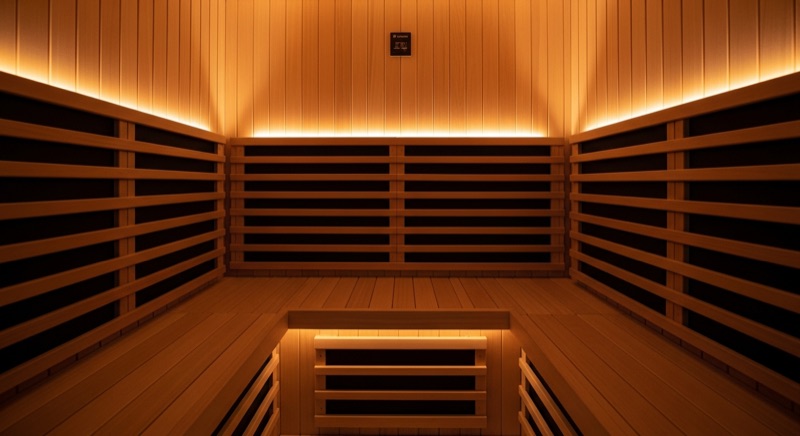
An infrared sauna does not really heat the air around you. It emits infrared wavelengths that pass through the air and warm your skin and the tissue underneath directly, the way sunlight feels warm on a cold day. That is why the cabin air stays a comfortable 120 to 150 F while you still sweat hard. The heating is radiant and dry.
A hot tub does the reverse. It holds water at 100 to 104 F and heats you by immersion, conducting warmth into your body from every surface the water touches. Water carries heat far more efficiently than air, so 104 F water feels much hotter than 104 F air. You also get two things the sauna cannot give you: buoyancy, which unloads your joints and spine, and hydrostatic pressure, which gently compresses tissue and can help circulation.
That mechanical difference drives everything downstream. The sauna is the better tool for a strong internal heat dose. The hot tub is the better tool for taking load off sore, stiff joints while you soak.
Core Temperature and Cardiovascular Effect
Both raise core temperature and both make your heart work, but the sauna pushes harder on the cardiovascular side. A proper infrared session drives core temperature up over 30 to 40 minutes and produces a sustained rise in heart rate that some researchers compare to moderate exercise. That repeated heat stress is the mechanism behind sauna heart-health signals: improved vascular function and lower resting blood pressure over time. We cover the evidence in our guide to infrared sauna and heart health.
A hot tub at 102 F warms you and raises heart rate too, and warm-water immersion does lower blood pressure acutely. But most people soak at a cooler effective dose than a full sauna session delivers, and the buoyancy keeps the experience gentle rather than taxing. If your priority is cardiovascular conditioning through heat, the sauna is the stronger stimulus. If your priority is a calm warm soak with a mild cardiovascular benefit, the tub does the job.
Muscle Recovery and Soreness
This is where the answer genuinely depends on the day. Right after a brutal session, when your legs are heavy and your joints ache, the hot tub tends to feel better. Buoyancy takes weight off the joints, the jets deliver a crude massage, and the immersion is soothing on acute soreness. For same-day relief, water wins on comfort.
For the recovery habit that actually moves the needle over weeks, the sauna has the edge. Deep radiant heating boosts blood flow to muscle, supports the heat-shock response tied to tissue repair, and builds heat tolerance you can carry into training. And the sauna slots into the single best recovery protocol most people can do at home: heat followed by cold. Pairing a sauna with a plunge, not a warm tub, is what creates the sharp vasoconstriction contrast. Our sauna and cold plunge routine walks through the timing. The short version: sauna for the recovery adaptation, hot tub for the day-of comfort.
The Real Cost: Buying and Running
The sticker price is only half the story. A hot tub is one of the few home purchases where the running cost can rival the purchase over its life. Here is the honest breakdown.
The gap is stark. A hot tub keeps several hundred gallons of water hot 24 hours a day, so it draws power even when nobody uses it. In a cold climate or a poorly insulated model, the monthly electricity alone can top 60 dollars. A sauna only draws power for the 40 minutes you are inside, then it is off. For a deeper breakdown of sauna running numbers, see our guide to infrared sauna cost. Over five years of ownership, the running-cost difference alone can exceed 3,000 dollars in the hot tub's disfavor.
Maintenance Burden
A hot tub is a small body of warm water, which means it is a small chemistry project you never finish. You test and balance sanitizer, pH, and alkalinity every week, clean or replace filters, and drain and refill the whole tub every three to four months. Skip it and you get cloudy water, biofilm, and skin irritation. It is not hard, but it is a standing chore.
An infrared sauna is close to maintenance free. Wipe the benches after a sweaty session, air it out, and that is essentially it. No water chemistry, no filters, no draining. If you dislike ongoing upkeep, this difference alone may decide the purchase.
Space and Installation
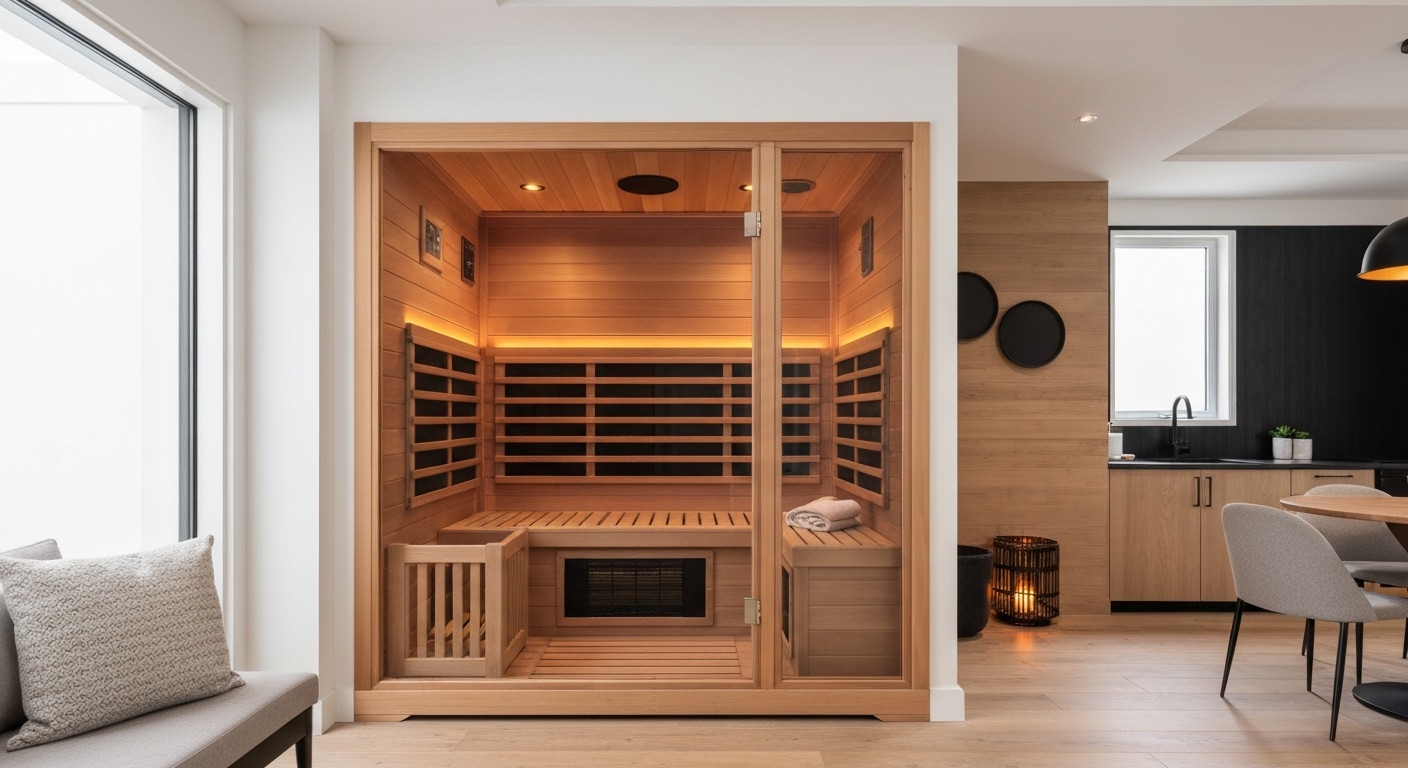
A one or two person infrared sauna occupies about a square meter of floor and plugs into a standard household outlet in most cases. It lives happily indoors: a spare bedroom, a basement corner, a garage. You assemble it in an afternoon and it is ready.
A hot tub is a heavier commitment. Filled, it can weigh well over 3,000 pounds, so it needs a level, load-rated concrete pad or a reinforced deck. Larger models often want a 240V dedicated circuit and an electrician. It typically lives outdoors, needs clearance for the cover and side panels, and once it is placed and plumbed, moving it is a project. If your space is tight or indoor-only, the sauna is the practical pick.
Calories, Sweat, and Weight
Neither is a weight-loss machine, and anyone selling one as such is overpromising. A sauna does raise heart rate and burn a modest number of extra calories during a session, plus you lose water weight through sweat that returns as soon as you rehydrate. A hot tub burns very little beyond baseline, since you are floating and relaxed rather than heat-stressed. If a calorie edge matters to you at all, it is a small one, and it belongs to the sauna.
Sleep
Both help sleep through the same well-studied trick. Warming the body pulls blood to the skin, and the core-temperature drop afterward is a strong signal to fall asleep. A warm soak or a sauna session 60 to 90 minutes before bed can meaningfully speed sleep onset. The hot tub has a slight ritual advantage here, since a quiet warm soak is one of the most relaxing wind-downs there is, but the sauna produces the same physiological afterdrop. If sleep is your main goal, read our guide to using an infrared sauna for sleep and time your session for the evening.
Choose an Infrared Sauna If...
- +You want the strongest heat-therapy and cardiovascular dose, not a gentle soak.
- +Running cost matters and you would rather pay cents per session than tens of dollars a month.
- +You hate ongoing maintenance and want to skip water chemistry entirely.
- +Your space is indoor, tight, or served only by a standard outlet.
- +You plan to pair heat with cold plunges for contrast recovery.
Choose a Hot Tub If...
- +You want a social, shared experience more than a solo recovery tool.
- +Buoyant joint relief and jet massage matter for stiff or arthritic joints.
- +You have outdoor space, a load-rated pad, and can wire a dedicated circuit.
- +A warm evening soak is your ideal wind-down ritual.
- +You accept 40 to 90 dollars a month and weekly upkeep as the price of that.
Can You Have Both?
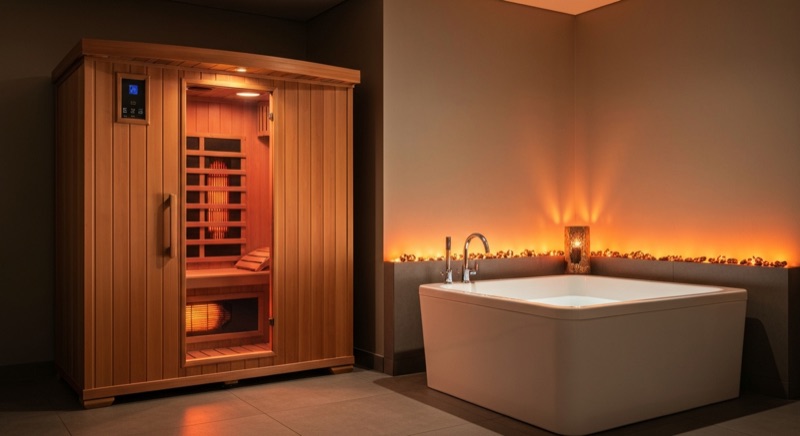
Plenty of people do, and the two complement each other well. The classic pairing is not sauna plus hot tub, though: it is sauna plus cold. Heat opens the vessels and raises core temperature, then cold water snaps them shut, and that contrast is where a lot of the recovery and mood benefit lives. If you have the budget and the space, a sauna and a cold plunge is the more effective recovery duo than a sauna and a warm tub.
That said, a warm hot tub after a sauna is a lovely, low-stakes way to relax before bed, and if you value the social soak, there is no reason not to own both. If you are still weighing the sauna question itself against another dry-heat option, our comparison of infrared sauna vs steam sauna is the next stop.
The Verdict
If you are buying one machine for health and recovery and you care about what it costs to run, buy the infrared sauna. It delivers the stronger heat dose, the better cardiovascular stimulus, near-zero running cost, no maintenance, and an easy indoor install. Over five years it is dramatically cheaper to own, and it plugs into the most effective home recovery protocol there is.
Buy the hot tub if the experience you actually want is a warm, social soak that unloads your joints and winds you down at night, and you are comfortable with the ongoing cost and upkeep. It is a genuinely great relaxation and joint-relief tool. It is just an expensive one to keep alive, and it is not the recovery workhorse the sauna is. Match the tool to the job, and most people chasing recovery and value land on the sauna.