Sauna Blanket vs Infrared Sauna: Which Is Worth It?
These two products get sold as alternatives, and they are, but only along one axis. A sauna blanket delivers a comparable sweat and much of the heat-therapy effect for a fraction of the price and none of the floor space. What it cannot do is heat a room. It wraps your body instead, and that single design difference decides the comfort, the session, the capacity, the cleaning, and the resale. Here is the honest comparison, dimension by dimension.
Buy a blanket if you rent, live in a small space, travel, have under 600 dollars, or want to test whether you will really sweat three times a week before committing thousands. Buy a cabin if two or more people will use it, if you want to sit up and stay 40 minutes in comfort, or if you plan to use heat daily for years. A blanket costs 5 to 15 percent of a cabin and produces a genuinely heavy sweat. It just cannot match a cabin on comfort, head and airway cooling, capacity, lifespan, or resale.
Sauna Blanket vs Infrared Sauna at a Glance
The figures below are typical market ranges for home units in 2026, not the extremes at either end. Blanket prices cluster between 200 and 600 dollars, with the well-known wellness brands sitting near the top of that band. Cabins start around 1,000 dollars for a one-person unit and run past 8,000 for a full-spectrum four-person build.
| Dimension | Sauna Blanket | Infrared Cabin |
|---|---|---|
| Price | $200 to $600 | $1,000 to $8,000+ |
| Space needed | Zero permanent space, folds to a duffel | 3 to 16 sq ft of dedicated floor |
| Setup / pack away | About 5 minutes each way | Assembly of 1 to 4 hours, then permanent |
| Heat-up time | 8 to 15 minutes | 15 to 30 minutes to reach set point |
| Temperature range | 95 to 175 F at the surface | 110 to 150 F cabin air |
| Sweat intensity | Heavy, sealed, no evaporation | Heavy, dry, sweat evaporates |
| EMF profile | Element sits millimetres from skin | Panel sits 6 to 18 inches away |
| Capacity | 1 person, always | 1 to 6 people depending on model |
| Lifespan | Roughly 2 to 4 years of regular use | 10 to 20 years, panels replaceable |
| Maintenance | Wipe the interior after every session | Wipe benches weekly, air it out |
| Resale value | Near zero, hygiene kills the market | Real, cabins resell used |
| Best for | Renters, travel, small budgets, trialling the habit | Households, couples, daily long-term use |
Read that table as one trade: you are giving up the room, the capacity, and the decade of service in exchange for saving roughly 1,500 to 7,500 dollars and a corner of your home. If you want to see which specific blankets are worth the money once you have made that trade, our roundup of the best infrared sauna blankets covers the models and the material questions in detail. This page is about the decision that comes first.
The Heat Reaches You in Two Different Ways
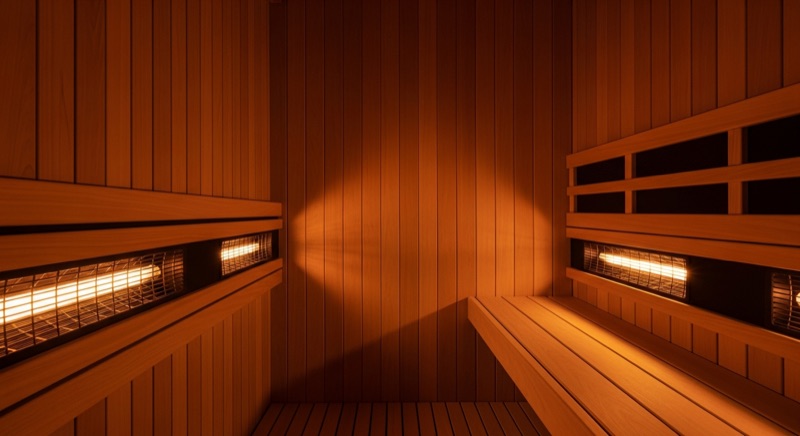
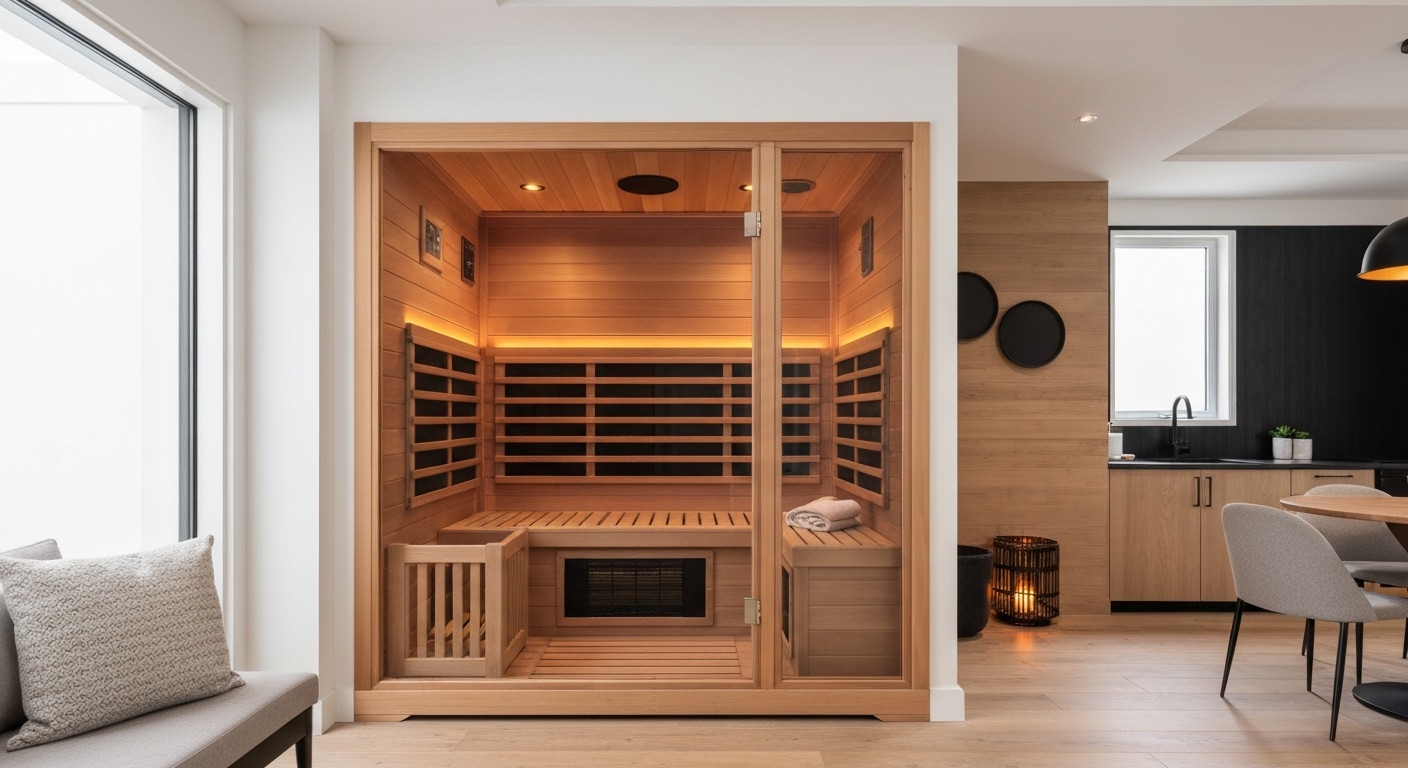
A cabin heats you with radiant panels mounted on the walls, floor, and bench, typically 6 to 18 inches from your body. The air warms to 110 to 150 F as a side effect, but the work is done by infrared passing through the air onto your skin. Because the air is dry and moving slightly, sweat evaporates off you, which is why a 45-minute cabin session stays tolerable even at 140 F.
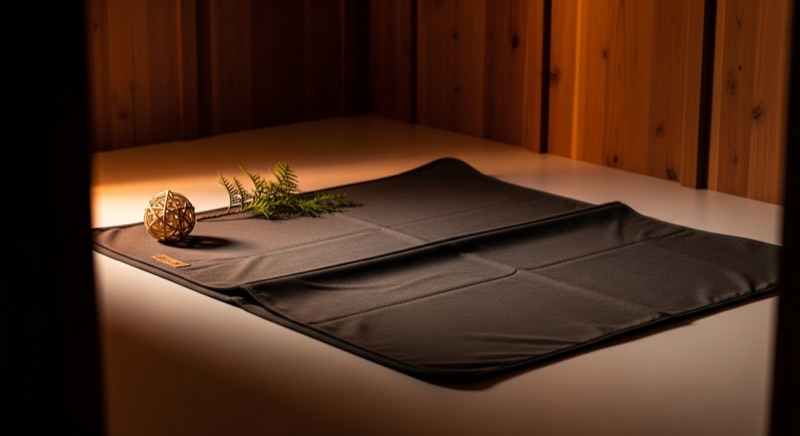
A blanket does the same thing at zero distance, and adds conduction. The heating layer sits directly against your skin through a thin fabric barrier, so a surface setting of 160 F transfers heat far more aggressively than 160 F air ever could. The bag is also sealed, so humidity climbs inside it and evaporative cooling stops almost entirely. That is why blankets run hot fast and why many people cap sessions at 30 to 45 minutes rather than the hour a cabin allows.
What the Experience Actually Differs On
This is the difference nobody explains before you buy. In a blanket, you lie flat on the floor or a bed, zipped into a body-length bag with your head sticking out of the top. Your arms are usually pinned at your sides unless the model has arm slots. You cannot reach your phone easily, you cannot sit up, you cannot get out in one second. A meaningful minority of people find that claustrophobic, and no amount of reading about it in advance tells you whether you will be one of them.
Having your head outside the bag is a genuine advantage and a genuine limitation at the same time. Your face and airway stay cool, so you never get the hot-air-in-the-throat sensation that some people dislike in a traditional sauna, and breathing stays easy at high settings. But your head and neck get no heat at all, so the exposure is not full-body in the way a cabin session is. If you value that scalp-and-shoulders warmth, the blanket will feel incomplete.
A cabin is a small room, and that changes what you do in it. You sit upright, shift position, stretch, read a paperback, run a podcast through the panel speaker, or talk to whoever is on the bench next to you. That last point is not a small one: a two-person cabin turns the session into shared time. A blanket is a solo appliance by physical design, and no model will ever change that.
Sweat and Core Temperature: Blankets Perform
It would be easy to dismiss blankets as a gimmick, and it would be wrong. A blanket at a normal working setting raises core temperature and produces heavy, sustained sweating. Most people are visibly sweating inside 10 to 15 minutes, faster than in a cabin that has to spend 15 to 30 minutes climbing to its set point. Over a 40-minute session, sweat volume is broadly comparable, because the sealed interior stops evaporation and the sweat simply pools on you instead of leaving.
The physiological response people are chasing with heat therapy, an elevated heart rate, peripheral vasodilation, and the pleasant flattened calm afterwards, is present in a blanket session. If your goal is sweat, a wind-down before sleep, and post-training warmth, a blanket delivers that for 300 dollars. What no sauna in any format does, blanket or cabin, is detoxify the body. Sweat is thermoregulation. Your liver and kidneys handle detoxification, and any product claiming otherwise is selling a story rather than a mechanism.
A blanket is not a cheap imitation of a cabin. It is a different delivery format that hits the same physiology on the body and misses it on the head, at 5 to 15 percent of the cost. Judge it as a sweat-and-relax tool and it performs well. Judge it as a room you can sit in with your partner and it fails, because it was never that.
Price, Running Cost, and the Ten-Year Math
A blanket costs 200 to 600 dollars and draws roughly 400 to 800 watts, so a 45-minute session costs a few cents of electricity. A cabin costs 1,000 to 8,000 dollars, draws 1.5 to 3 kW, and adds a delivery and assembly burden that a blanket does not have. Some larger cabins want a dedicated 20-amp or 240V circuit, which is an electrician call before you have taken a single session. Our guide to infrared sauna cost breaks down where the cabin money actually goes.
The ten-year comparison is less lopsided than the sticker price suggests. If a blanket lasts 3 years and you replace it three times, you spend 600 to 1,800 dollars over a decade and end with nothing. A 3,000 dollar cabin over the same decade costs 300 dollars a year, retains resale value, and is still working. Blankets win decisively on the first-year outlay. Cabins close a lot of that gap if you genuinely use heat for years.
Space, Setup, and Portability
A one-person cabin occupies roughly 3 to 4 square feet of permanent floor, a two-person around 8 to 10, and a four-person up to 16. It arrives in heavy panel boxes, takes one to four hours to assemble depending on the model, and once it is up you do not move it again casually. Renters have the extra problem that it is a large object to relocate at the end of a lease.
A blanket unrolls in about 5 minutes, preheats in 8 to 15, and folds back into a bag afterwards. It fits in a closet, under a bed, or in a large suitcase, which is the reason it is the only real heat-therapy option for people who travel or move often. If you want the middle ground, a folding one-person tent sits between the two formats, and our roundup of the best portable infrared saunas covers those. A tent lets you sit upright with your head out while still packing away, at roughly 300 to 900 dollars.
Cleaning and Hygiene: The Daily Tax
This is the chore people underestimate. Because a blanket is sealed and non-absorbent inside, every drop of sweat you produce stays on the interior surface. You wipe it down after every single session, and you leave it open to dry fully before folding, or you get odour and eventually mildew at the fold lines. Most owners end up using a cotton insert, a long-sleeved base layer, or a towel liner, which adds laundry to the routine but keeps the vinyl or PU surface much cleaner.
A cabin asks far less. Wood absorbs and releases moisture, air circulates, and a weekly wipe of the benches plus leaving the door ajar to air out covers most of it. A deeper clean of the interior a few times a year is usually enough, and our walkthrough of how to clean an infrared sauna lays out the routine. If you know you will resent a per-session chore, weight this dimension heavily, because it is the one that quietly kills blanket habits.
EMF: It Matters More in a Blanket, Not Less
Field strength from a heating element falls off sharply with distance. In a cabin you sit 6 to 18 inches from the panel, which does most of the work for you before any shielding is involved. In a blanket the element is separated from your skin by a few millimetres of fabric. Whatever that element emits, you receive at essentially zero distance across most of your body surface for the whole session.
The practical response is not to avoid blankets. It is to treat low-EMF construction as a selection criterion rather than a nice-to-have. Look for manufacturers who publish measured figures rather than vague claims, who use shielded or twisted-pair heating wire, and who supply or permit a cotton insert between you and the element layer. The same shopping logic applies on the cabin side, and our guide to the best low EMF infrared saunas explains what the published numbers mean and which ones are worth trusting.
Durability, Repairs, and Resale
A blanket is a flexible electrical appliance that gets folded, heated, and sweated on repeatedly. Expect 2 to 4 years of life at 3 or more sessions a week. Failures are boringly predictable: the zipper goes first on many units, the fold line eventually stresses the internal wiring, and controller or connector faults account for most of the rest. Repairs are rarely economical, so a failure is a replacement.
A cabin is furniture with electronics in it. Cedar or hemlock panels, carbon or ceramic emitters, and a wall controller commonly run 10 to 20 years, and a dead panel is a part swap rather than a write-off. Resale reflects that split cleanly. Used cabins sell, sometimes at 40 to 60 percent of new after a few years. Used blankets are close to unsellable, because nobody wants a secondhand item that another person sweated inside for three years. If getting money back matters to you, only one of these two formats offers it.
Choose a Sauna Blanket If...
- +You rent, move often, or cannot give up 3 to 16 square feet of permanent floor.
- +Your budget is under 600 dollars and you want the sweat now, not in two years of saving.
- +You travel and want heat therapy in a suitcase.
- +You are testing whether you will actually use heat 3 times a week before spending thousands.
- +You will only ever use it alone, and lying down for 30 to 45 minutes suits you.
Choose an Infrared Cabin If...
- +Two or more people in the household will use it, or you want to share sessions with a partner.
- +You want to sit upright, read, stretch, and stay in comfortably for 40 minutes or more.
- +You own your home and can give up a corner permanently.
- +You expect to use heat several times a week for years, where the 10-year cost per session drops below a blanket habit.
- +You want a fixture that holds resale value and can be repaired panel by panel.
Can You Use Both?
Owning both is a legitimate combination, and it is more common than the marketing suggests. The cabin is the home session: longer, upright, shared, the one you build a weekly routine around. The blanket is the travel and overflow unit, the thing that goes in the car for a week away or gets used on a night when the cabin is occupied. At 200 to 600 dollars, a blanket is a small add-on next to a cabin you already own.
The sequence that works best for most people is blanket first, cabin later. Spend 300 dollars, run it for six months, and count your actual sessions. If you managed two or three a week without forcing it, you have proven the habit and a cabin is a sound purchase. If the blanket sat folded in the closet after week five, you have learned that for 300 dollars instead of 3,000, which is the cheapest useful lesson in this category.
The Verdict
A sauna blanket is worth it, with a clear boundary on the claim. It delivers a comparable sweat, real heat exposure, and most of the relaxation benefit for 5 to 15 percent of a cabin price, in zero permanent space, ready in 15 minutes. For renters, travellers, small apartments, tight budgets, and anyone unsure whether heat therapy will stick, it is the correct first purchase, and dismissing it is snobbery rather than analysis.
A cabin is the better long-term machine, and the gap is about everything except the sweat. You get comfort, an upright posture, head and shoulder exposure, room for a second person, a decade or two of service, repairable parts, and resale value. If two people will use it, if you want sessions longer than 45 minutes, or if you are certain heat is a permanent part of your week, buy the cabin and skip the intermediate step. Everyone else should start with the blanket and let their own session count decide the rest.