Best Budget Infrared Saunas 2026: Cheap and Affordable Picks by Price Tier
The best budget infrared sauna for most people is the Dynamic Saunas Barcelona at $1,200-1,500, a 2-person carbon-panel cabin that does everything a $6,000 unit does minus the cedar and the app. If your ceiling is lower, the LifePro Waverly at $899 is the best 1-person cabin, and the SereneLife portable at $249 is the cheapest way to get real far-infrared heat at home.
This is the full budget guide across every price tier, from $189 portables up to the $2,000 line where affordable stops and mid-range begins. Each tier below lists what you actually get, what gets cut, and named picks at real street prices.
Budget infrared saunas by price tier
Price is the only spec that matters until you know which tier you are shopping in. An affordable infrared sauna means three completely different products depending on whether your ceiling is $500, $1,000 or $2,000, and the gap between those tiers is larger than the gap between $2,000 and $5,000. Here is what each band buys in 2026.
A zip-up tent or a padded blanket with carbon film inside. Real far-infrared, no cabinet.
Genuine far-infrared emitters, 140-150 F inside the shell, zero assembly, folds into a closet, plugs into any 120V outlet and draws about 600-900 W.
No enclosed air temperature, your head sits outside the tent, 4-7 mG EMF at the panel, vinyl and polyester instead of wood, and a 1-year warranty on a product that realistically lasts 2-4 years.
Decision rule: Buy this tier only to find out whether you will actually use a sauna 3 times a week. If you do, you will outgrow it inside a year.
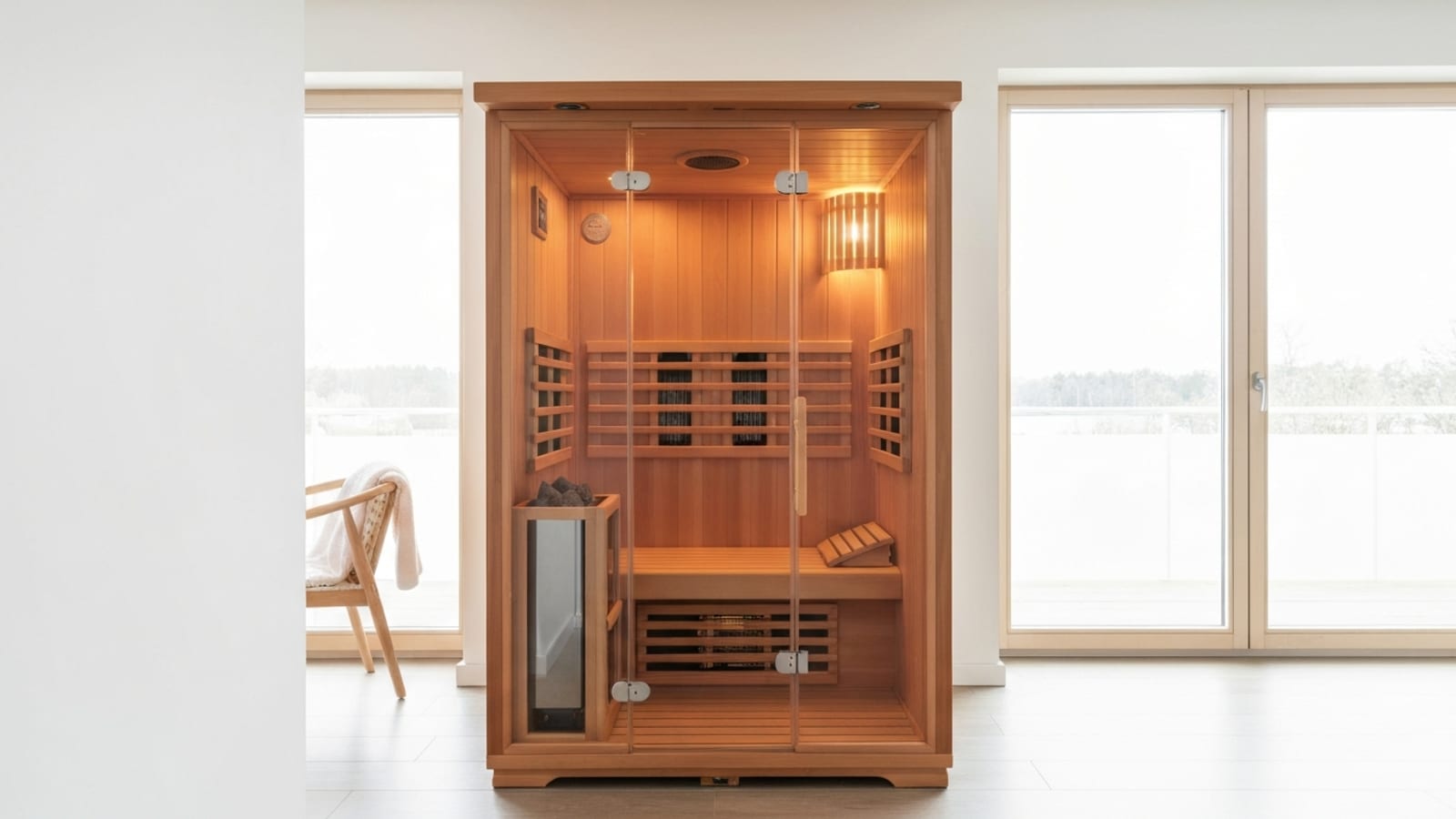
The cheapest real sauna: a hemlock box with a bench, a door, and 4-6 heating elements.
Canadian hemlock panels, a glass door, an enclosed 140 F air temperature, digital controls, and 120V plug-in on a standard 15A circuit. Assembly takes 45-90 minutes with two people.
One seat only, ceramic rods instead of carbon panels at the bottom of the band, no chromotherapy or Bluetooth below $800, and 1-3 year warranties split by component.
Decision rule: This is the value floor for a sauna you keep 5-10 years. Below $600 you are buying ceramic rods, which heat hotter but far less evenly.
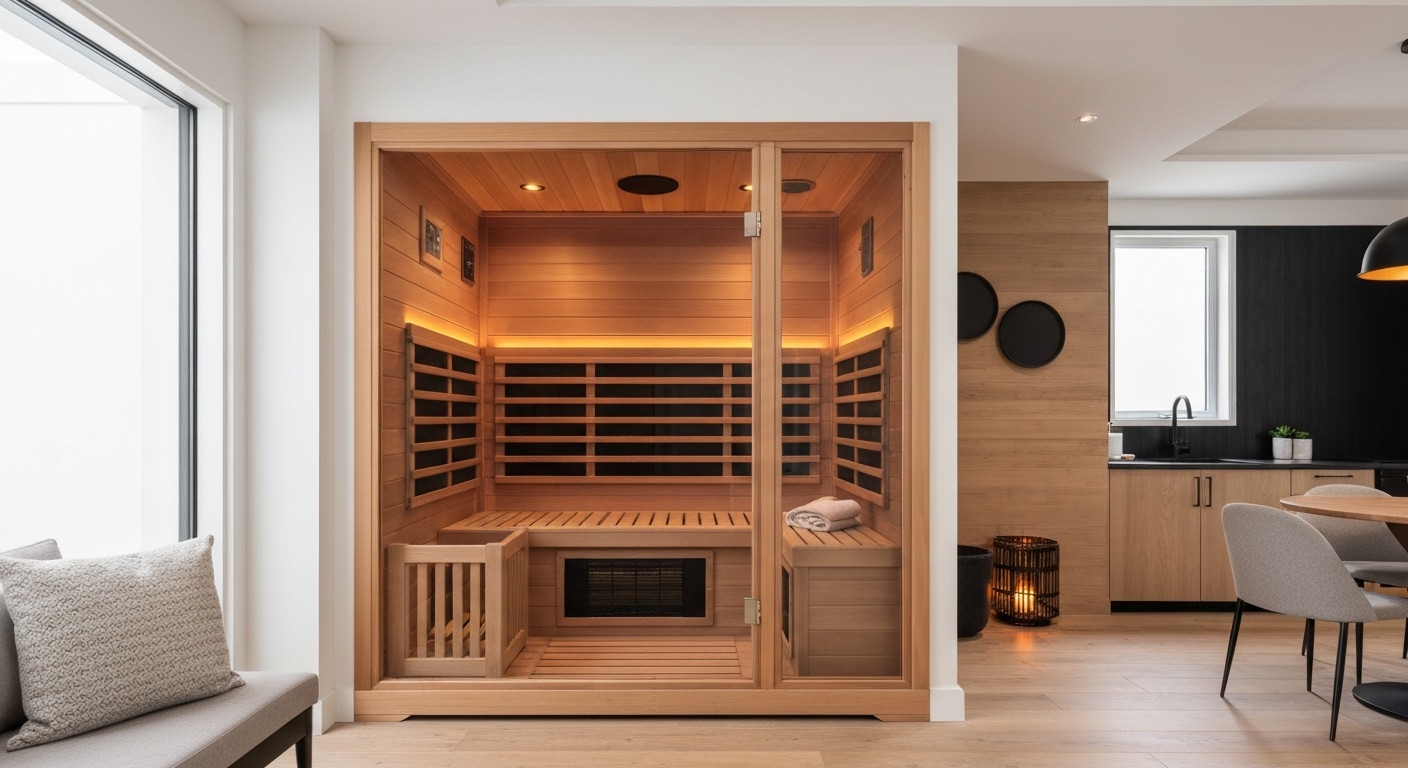
The sweet spot of the entire market: full carbon panel coverage and room for two.
Five to eight carbon far-infrared panels including back, side and calf coverage, hemlock cabinetry, 140 F, and often a foot heater, Bluetooth speakers and chromotherapy. Most 2-person units still run on 120V.
Hemlock rather than Western red cedar, standard low EMF rather than verified sub-0.5 mG at the seat, far-infrared only with no near-infrared, and warranties of 1-5 years rather than lifetime.
Decision rule: If you can reach $1,200, skip the two tiers above it. The jump from a 1-person cabin to a 2-person carbon cabin buys more than the jump from $2,000 to $4,000 does.
If your budget stops hard at four figures, we broke that band out separately: the best infrared saunas under $1,000 covers the six models that clear the $999 line, including the two portables and the $599 ceramic cabin listed above. This page stays focused on the wider budget picture up to $2,000.
When it is worth spending more than $2,000
Three things, and only three things, justify crossing the $2,500 line. Western red cedar, which resists moisture and smells like a sauna instead of like plywood. Full-spectrum heaters that add near and mid infrared for the wavelengths tied to skin and tissue research rather than heat alone. And third-party EMF testing that reports a figure at the seated position, not at the panel face, which is the only measurement that describes what your body is exposed to. If none of those three change how you would use the sauna, a $1,400 carbon cabin gives you the same session for a quarter of the money.
What you get (and do not get) under $2,000
Best budget infrared saunas 2026
| # | Model | Best for | EMF | Max temp | Score | Price | |
|---|---|---|---|---|---|---|---|
| 01 | Dynamic Barcelona 1-2 Person Dynamic Saunas | Best value entry point | Low | 140 F | 8.0/10 | $1,200-1,500 | Check → |
| 02 | Maxxus Seattle MX-J206-01 Maxxus | Best value overall | Low | 140 F | 8.4/10 | $2,000-2,300 | Check → |
| 03 | JNH Lifestyles Joyous 2-Person JNH Lifestyles | No-glue hemlock build | Low | 140 F | 8.1/10 | $1,600-1,900 | Check → |
| 04 | Dynamic Gracia 1-2 Person Dynamic Saunas | Lowest price carbon-panel | Low | 140 F | 7.8/10 | $1,200-1,600 | Check → |
Maxxus Seattle MX-J206-01
The Maxxus Seattle is the best-specified sauna in this budget tier. Six carbon panels, a dedicated foot heater, Bluetooth connectivity, and chromotherapy - features that typically cost significantly more elsewhere. Canadian hemlock construction. 120V for the 1-person configuration, 240V for the 2-person (verify at purchase).
The foot heater is a meaningful addition: foot panel warmth measurably improves overall thermal experience and helps the lower body reach target temperature, which is an area many budget saunas neglect.
Dynamic Saunas Barcelona 1-2 Person
The Dynamic Barcelona is the most recommended entry-level sauna in the under-$1,500 category. Five carbon far-infrared panels, hemlock wood, 120V operation, and a max temp of 140 F. It is a straightforward, honest sauna without premium features. It heats up, you sit in it, you sweat. That is the value proposition. Dynamic has one of the largest customer bases in the budget segment, meaning there is extensive real-world data and community troubleshooting for this model.
JNH Lifestyles Joyous 2-Person
JNH's Joyous 2-person is the mid-point between the Dynamic entry price and the Maxxus Seattle. Canadian hemlock with JNH's no-glue construction method. The no-glue approach means panels are mechanically interlocked, reducing potential off-gassing from adhesives. This construction detail appeals to buyers who have done research on materials. Eight carbon heating panels across all surfaces. Solid build quality for the price segment.
Dynamic Saunas Gracia 1-2 Person
The Dynamic Gracia overlaps price with the Barcelona but offers a slightly different size profile. If the Barcelona is unavailable or you need a specific dimension, the Gracia is the next Dynamic option. Functionally similar category. The score difference reflects slightly fewer panels and less refined controls compared to the Barcelona, but this is a small practical distinction.
What actually gets cut at each price point
Manufacturers do not build a cheap infrared sauna by making the same product worse. They remove specific parts. Once you know which eight parts move with price, every listing in the low cost segment becomes readable in about thirty seconds.
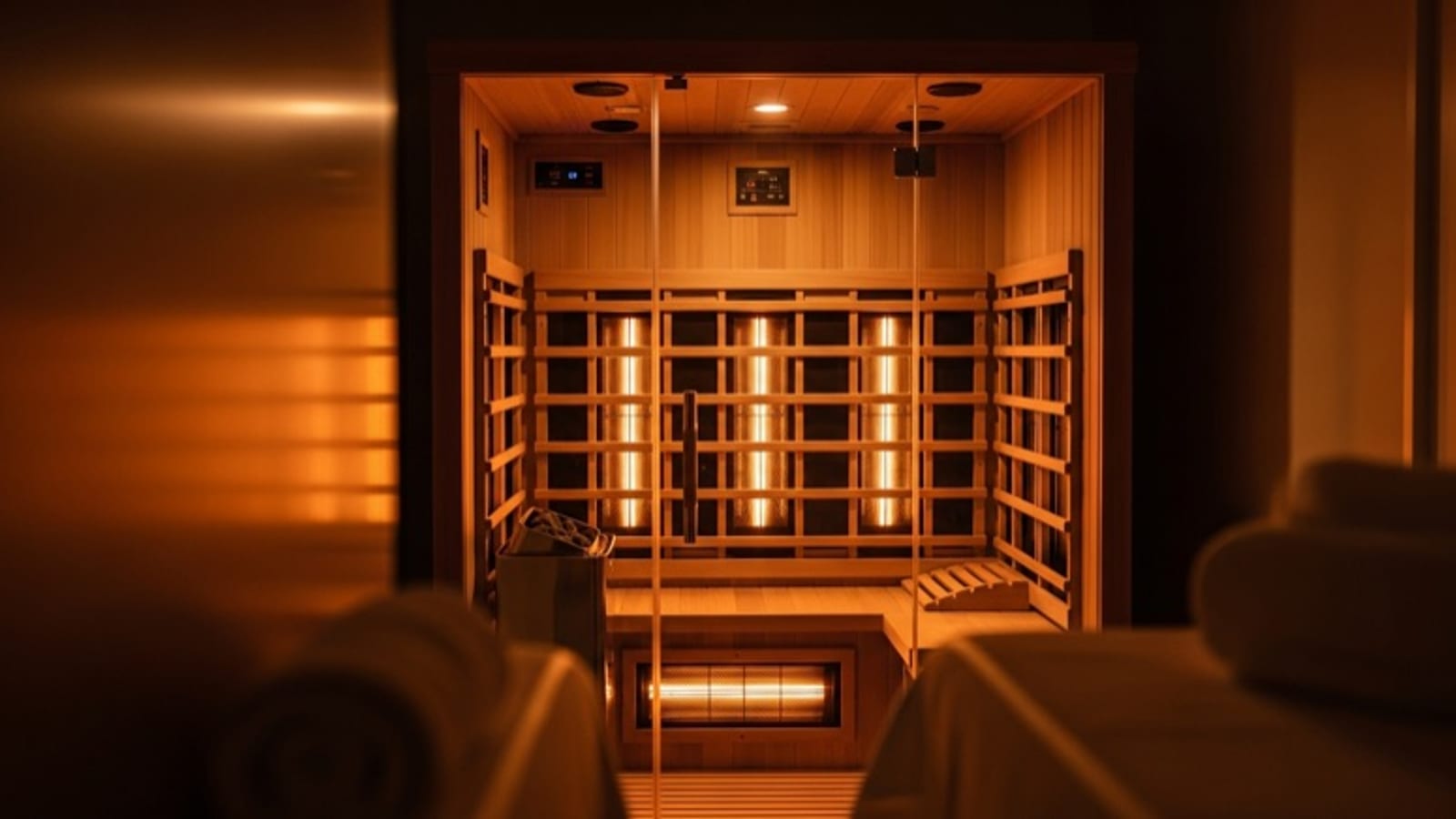
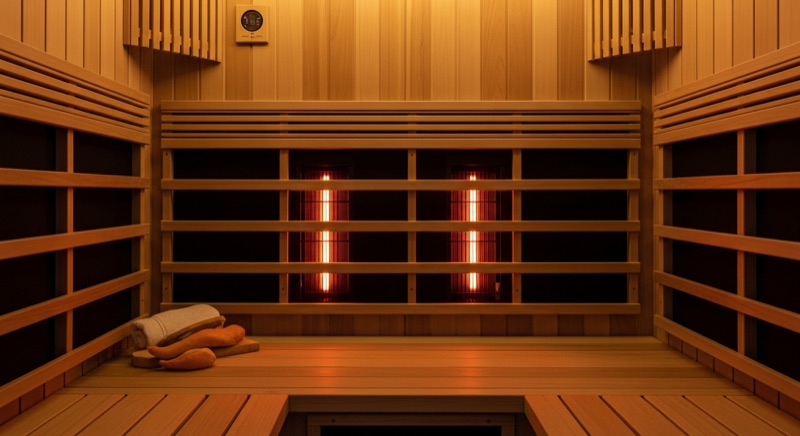
Heater type is the cut that matters most. Ceramic rods are cheaper to manufacture and reach a higher surface temperature, roughly 300-400 F against 150-200 F for carbon. That sounds like an upgrade and is not. Rods heat in narrow stripes, so your back cooks where a rod sits and stays cool two inches away, and they take longer to bring the cabin to temperature. Carbon panels spread the same wattage over a large flat surface, which is why every pick above $800 on this page uses them. A $599 ceramic cabin still works. It is just less pleasant to sit in for 40 minutes.
EMF is the cut that gets hidden. Budget brands quote a figure at the panel face because it is the number they can measure cheaply, and 3-8 mG is normal there. Premium brands quote at the seated position, where the field has dropped by an order of magnitude. The two numbers are not comparable, so a budget sauna claiming 3 mG is not beating a $7,000 sauna claiming 0.3 mG. What should worry you is a listing that gives no figure at all.
Wood grade is the cut you will notice daily. Canadian hemlock is a light, close-grained, low-odour softwood, and it is entirely adequate. Western red cedar costs $800-1,500 more on an equivalent cabin and buys natural rot resistance plus the smell people associate with saunas. Watch for the third option: unnamed "sauna wood" or veneered particleboard on marketplace listings, which swells at the seams within a couple of years of humid use.
Warranty is the cut that reveals the brand. Budget warranties are split by component: typically 5 years on the wood, 1-3 years on heaters, and 1 year on electronics, which is where failures actually happen. Read the electronics line, not the headline number. A brand offering 1 year on the controller and no US service address is telling you the unit is disposable.
What a cheap infrared sauna really costs to own
The sticker price is between 80 and 95 percent of the total on a budget unit, which is one of the genuine advantages of shopping this end of the market. There are still three line items to add before you compare two listings.
Freight: $0 to $250. Portables ship as parcels and are almost always free. Wooden cabins weigh 250-400 lb and move by LTL freight to the curb, not into the house. Free shipping is common at $1,200 and above, but check whether liftgate service and residential delivery are included, because those two surcharges are where a $99 shipping quote becomes $240.
Electrical work: $0 or $400 to $900. Every pick on this page except the largest 2-person configurations runs on a standard 120V outlet drawing 13-16 A, which means a dedicated 15A or 20A circuit and nothing else on it. If you are looking at a 3-person unit or a 240V model, add an electrician for a dedicated circuit. That single line item can cost more than the difference between two saunas you are comparing, so confirm the voltage before you decide. Our full infrared sauna cost breakdown walks through installation across every size class.
Running cost: about $0.15 to $0.30 per session. A 1.6 kW 2-person cabin pulls full power for a 15 minute preheat, then cycles at roughly 50-60 percent to hold 140 F. A 45 minute session works out near 0.9 kWh, which at the US average of about $0.17 per kWh is roughly 15 cents. Four sessions a week lands around $2.50 to $5 a month, less than most people expect and less than a single sauna studio visit. The electricity cost guide has the per-state math if your rate is well above average.
Budget saunas to avoid: six red flags
The difference between a good cheap sauna and a bad one is not price, it is disclosure. Every unit recommended on this page publishes its heater type, its EMF reading, and the name of the company honouring the warranty. Walk away from any listing that trips two or more of these.
Every legitimate manufacturer publishes a number, even an unflattering one. Silence means it was never measured. Ask by message before buying, and treat a non-answer as the answer.
Phrases like "advanced heating technology" or "nano carbon tourmaline" with no panel count and no wattage usually mean ceramic rods sold at carbon panel prices. You want a count, a material, and a total wattage.
Look for ETL or UL on the listing and on the unit. A 1.6 kW heater running unattended for 45 minutes is a real electrical load, and an unlisted controller is the actual risk in this category, not the infrared.
A random storefront name with no website, no phone number and no US address cannot service a warranty. When the controller fails in month 14, there is nobody to email. Established budget brands like Dynamic, JNH, Maxxus, LifePro and Radiant all have real support channels.
A 300 lb cabin advertised with $29 shipping is either quoting terminal pickup, which means you rent a truck, or the cost reappears at checkout. Get the delivered price before comparing anything.
A $3,999 list price permanently discounted to $1,299 is a $1,299 sauna. Judge it against the other picks at $1,299 rather than against the invented anchor, and ignore the countdown timer.
Frequently asked questions
What is the best infrared sauna under $2,000?+
What do you give up buying an infrared sauna under $2,000?+
Do budget infrared saunas actually work?+
What is the cheapest infrared sauna that is actually good?+
How much should I spend on an infrared sauna?+
Are cheap infrared saunas safe?+
Continue reading
All guides →