Best Corner Infrared Saunas 2026: Space-Efficient Picks for Awkward Rooms
Corner saunas fit into 90-degree room corners where rectangular units cannot. Measure carefully - the side walls are typically 47-52 inches each - and check panel count before buying, as corner geometry sometimes means fewer total heaters than a rectangular equivalent.
Corner saunas sit flush against two walls meeting at 90 degrees. Measure each wall from the corner outward at least 52 inches. Confirm ceiling height of 80 inches minimum (most are 75-78" tall). Also measure how the unit will enter your room - most corner saunas ship in large flat-pack boxes that require a clear path to the final location.
What makes a corner sauna different
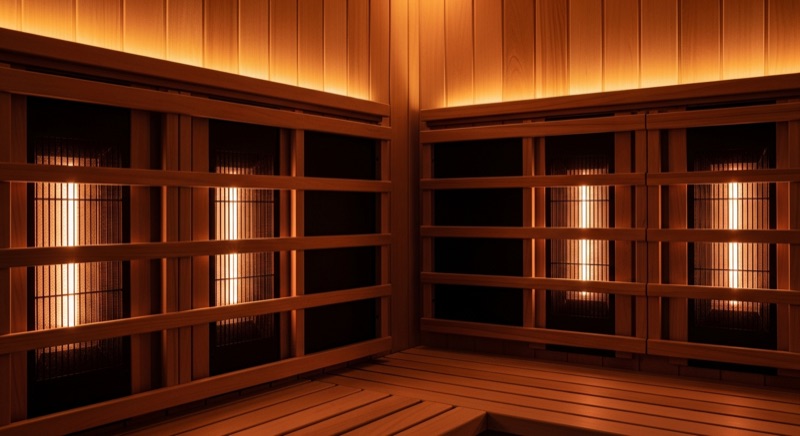
A corner sauna has two full side walls that sit flush against room walls, and an angled front face that spans between them. This geometry makes it more space-efficient when your room has an unused corner but not a free wall long enough for a rectangular unit. The typical footprint uses 47-52 inches on each wall with the front angled panel forming the hypotenuse.
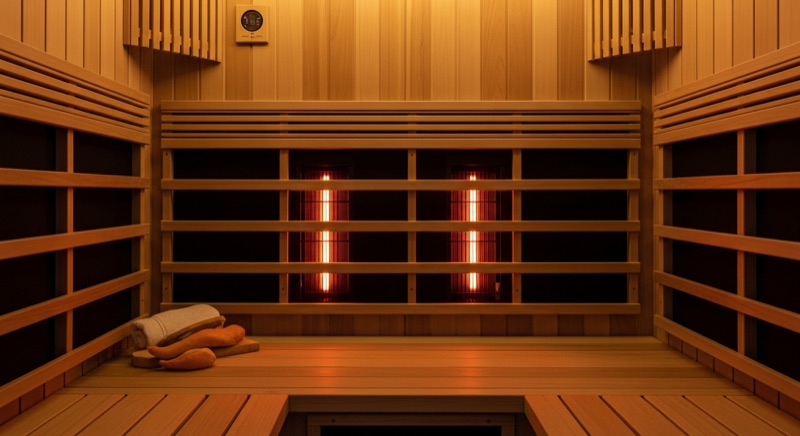
The interior is typically large enough for two people, though corner geometry often means a slightly different seating arrangement than a standard rectangular 2-person cabin. The angled front panel is typically where one heater is located, and the total panel count may be one or two fewer than a rectangular 2-person equivalent. This is worth checking before buying.
Why choose a corner infrared sauna
The main reason to pick a corner unit is space efficiency. A rectangular cabin needs a run of open wall about 5 feet long, which many rooms do not have once you account for doors, windows, and furniture. A corner sauna instead claims a 90-degree corner that usually sits empty. Two side walls press flush against the room, the angled glass front faces out into the space, and the footprint stays compact for the capacity it holds.
The angled glass front is not only about looks. A full glass front makes a small corner unit feel far less boxed in, lets you see out while you sit, and reflects heat back toward the bench. If you are comparing a corner unit against a small rectangular cabin for the same two people, read our best 2-person infrared saunas guide alongside this one, since a corner model is essentially a 2-person cabin reshaped to fit a corner.
A corner unit suits apartments, finished basements, spare bedrooms, and en-suite bathrooms where a rectangular cabin would block a walkway or a doorway. The trade is bench length: the angled front eats into the interior, so each seat is a little shorter than the same-capacity rectangular model. If your priority is stretching out rather than saving floor space, a rectangular cabin is the better fit.
Corner sauna sizing and placement
A corner unit uses the two walls of a room corner as its own back walls. A typical 2-person corner sauna measures 47-52 inches along each of those two walls, stands 75-78 inches tall, and needs a diagonal reach into the room of roughly 44-48 inches from the corner point out to the front glass. A 3 to 4 person corner model stretches the side walls to about 59-63 inches, so measure before assuming a bigger unit will fit the same corner.
Leave 2-4 inches of clearance behind and beside the cabin for airflow and to reach the control box. The door on most corner units is set into the angled front and swings outward, so keep 24-30 inches of clear floor in front of it. Confirm ceiling height of at least 80 inches, and check that the flat-pack boxes can actually reach the corner without a tight turn through a narrow doorway.
A corner unit suits you if your usable wall space is broken up but you have a spare corner. A standard rectangular cabin suits you better if you have one long open wall, want maximum bench length, or plan to fit three or more people who all want to recline. Match the shape to the room you actually have, not the one you wish you had.
What to look for in a corner sauna
Start with capacity. Most corner units are 2-person; larger 3 to 4 person models exist but need a bigger corner and usually a 240V circuit. Decide how many people will realistically use it at once and buy for that, since a 4-person unit you rarely fill just costs more to heat.
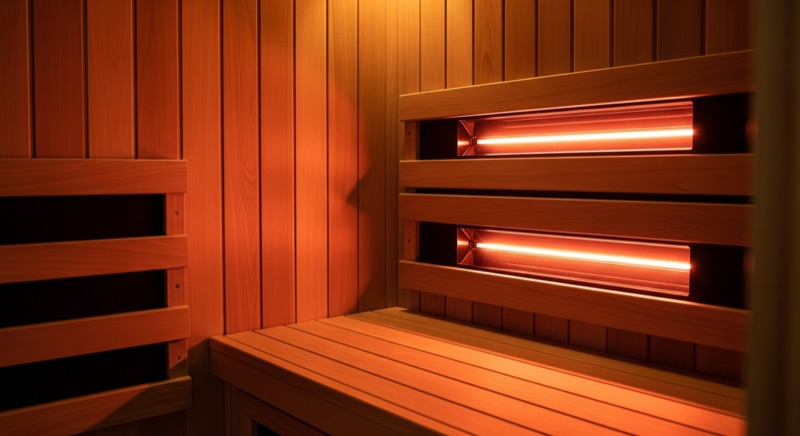
Then check heater count and placement. Corner geometry changes where panels sit: you want heaters behind the back of each seat, along both side walls, and in the front angled section near your calves and feet, not just clustered on the two rear walls. Count the total panels and compare them against a rectangular unit of the same capacity, since the angled shape sometimes drops one panel. Ask for the panel wattage as well as the count.
EMF matters more in a corner unit because you sit close to two walls of panels at once. Look for a measured low-EMF or ultra-low-EMF rating at the seated position, not just a marketing claim; our best low EMF infrared saunas guide explains what the numbers mean. For wood, Canadian hemlock and basswood are the common choices and both are fine; basswood is a better pick if you are sensitive to wood scent. Finally, weigh the glass: a full angled glass front opens up a small unit, while a solid front with a glass door keeps more heat but feels more enclosed.
Comparison: best corner saunas 2026
| # | Model | Best for | EMF | Max temp | Score | Price | |
|---|---|---|---|---|---|---|---|
| 01 | Dynamic Andora 2-Person Corner Dynamic Saunas | Best value corner sauna | Low | 140 F | 8.3/10 | $1,800-2,200 | Check → |
| 02 | Maxxus 2-Person Corner Maxxus | Mid-range value | Low | 140 F | 8.5/10 | $2,200-2,800 | Check → |
| 03 | JNH Lifestyles 2-Person Corner JNH Lifestyles | No-glue construction | Low | 140 F | 8.2/10 | $2,000-2,500 | Check → |
| 04 | Dynamic Barcelona 4-Person Corner Dynamic Saunas | Best 4-person corner | Low | 140 F | 8.4/10 | $2,800-3,400 | Check → |
| 05 | Clearlight Sanctuary Corner Clearlight | Premium full-spectrum | Ultra-low | 150 F | 9.2/10 | $7,000+ | Check → |
Product reviews
Maxxus 2-Person Corner Sauna
The Maxxus 2-person corner is the best-balanced option in the mid-range corner category. Canadian hemlock construction, carbon far-infrared panels, and a low-EMF rating. The build quality is a step above the Dynamic Andora at a moderate price increase. Chromotherapy lighting included. The control panel is straightforward.
The 240V requirement applies to the 2-person model - verify your electrical situation before ordering. Maxxus has solid customer service reputation and provides replacement parts.
Dynamic Saunas Andora 2-Person
The Dynamic Andora is the most accessible entry point for a corner sauna. Hemlock construction, carbon panels, low-EMF claim, and 120V operation on a 1-person configuration (the 2-person requires 240V - verify model-specific specs). Dynamic has a large US customer base and review history. It is the right choice for buyers who want a functional corner unit at the lowest reasonable price. Build quality reflects the price - not premium, but functional and adequately durable.
JNH Lifestyles 2-Person Corner
JNH's corner unit uses their no-glue construction method - the panels interlock mechanically rather than relying on adhesives. This is a durability and off-gassing consideration that matters to some buyers. Canadian hemlock, carbon FIR panels, and a solid warranty. Priced between the Dynamic and Maxxus options, JNH is a credible choice particularly for buyers who prioritize the no-glue construction.
Dynamic Barcelona 4-Person Corner
If you want a corner unit that seats more than two, the Dynamic Barcelona is the one to look at first. It steps the side walls up to roughly 59-63 inches so three, or four at a squeeze, can sit around the angled front. Hemlock construction, carbon far-infrared panels, a low-EMF claim, and a full glass front keep it from feeling cramped for its capacity. It needs a 240V dedicated circuit and a genuinely larger corner, so measure both walls before ordering. For families or couples who want room for guests without giving up the corner format, it is the practical mid-price pick.
Clearlight Sanctuary Corner
The Clearlight Sanctuary Corner is the premium option for buyers who want both corner geometry and ultra-low EMF performance. Full-spectrum heaters (NIR/MIR/FIR), ultra-low EMF at seated position, lifetime warranty, and medical-grade build quality. At $7,000+ it is a different purchase category from the Dynamic and Maxxus options. Clearlight has a strong track record for after-sale support and long-term reliability. For the corner format specifically, it is the best-built unit available.