Carbon vs Ceramic Infrared Sauna Heaters: Which Is Better?
Almost every infrared sauna under 10,000 dollars uses one of two heating elements: ceramic rods that run scorching hot over a small area, or carbon fiber panels that run warm over a large one. The choice changes how the heat feels on your skin, how long you wait to start, how much EMF you sit in, and what a replacement part costs eight years from now. Here is the full comparison.
Carbon is the better heater for most people. It covers far more wall area at a much lower surface temperature, so the heat lands evenly instead of roasting whichever body part sits closest to a rod, and its flat element is straightforward to shield for low EMF. Ceramic keeps two genuine advantages: it brings the cabin up to temperature in about a third of the time, and it costs less to build, which is why it owns the entry level shelf.
- 01Radiating area matters more than rated watts. Two 1,600 W saunas feel completely different if one spreads that power over 4 square feet of emitter and the other over 40.
- 02Ceramic elements peak near 4 to 5 microns, carbon panels near 8 to 9 microns. Both are far infrared, but carbon sits closer to the 9.4 micron band the human body itself radiates.
- 03Carbon is what low EMF brands use because a flat resistive sheet can be wired to cancel its own field and backed with a grounded shield.
- 04Ceramic rods are cheaper to replace individually. Carbon panels last longer and are more often covered by a lifetime element warranty.
Carbon vs ceramic head to head
| Heater type | Surface temp | Heat-up time | Evenness | EMF profile | Typical lifespan | Price tier | Best for |
|---|---|---|---|---|---|---|---|
| Ceramic rods / tubes | 500-700 F | 10-15 min | Uneven, clear hot and cold zones | Often 3-20 mG at panel face on unshielded budget builds | 3,000-5,000 hours | $800-2,000 | Fast sessions, tight budgets, cold garages |
| Carbon fiber panels | 150-200 F | 25-40 min | Very even, no scorching close up | Under 1 mG at the seat on properly shielded low EMF builds | 10+ years, often lifetime element warranty | $1,500-6,000 | Comfort, long sessions, EMF sensitivity |
| Carbon-ceramic hybrid | 150-700 F by zone | 15-25 min | Even base heat with deliberate intense zones | Depends entirely on build, verify the seated reading | Carbon 10+ years, ceramic zones 3,000-5,000 hours | $2,500-8,000 | Buyers who want coverage plus targeted intensity |
How each heater actually works
Both element types do the same job by the same physics. Electricity passes through a resistive material, the material gets hot, and the hot surface radiates infrared energy that your skin and the first few millimetres of tissue absorb. Everything that separates them comes from one design decision: how much surface area the manufacturer gives that heat to escape from.
Ceramic rods and tubes
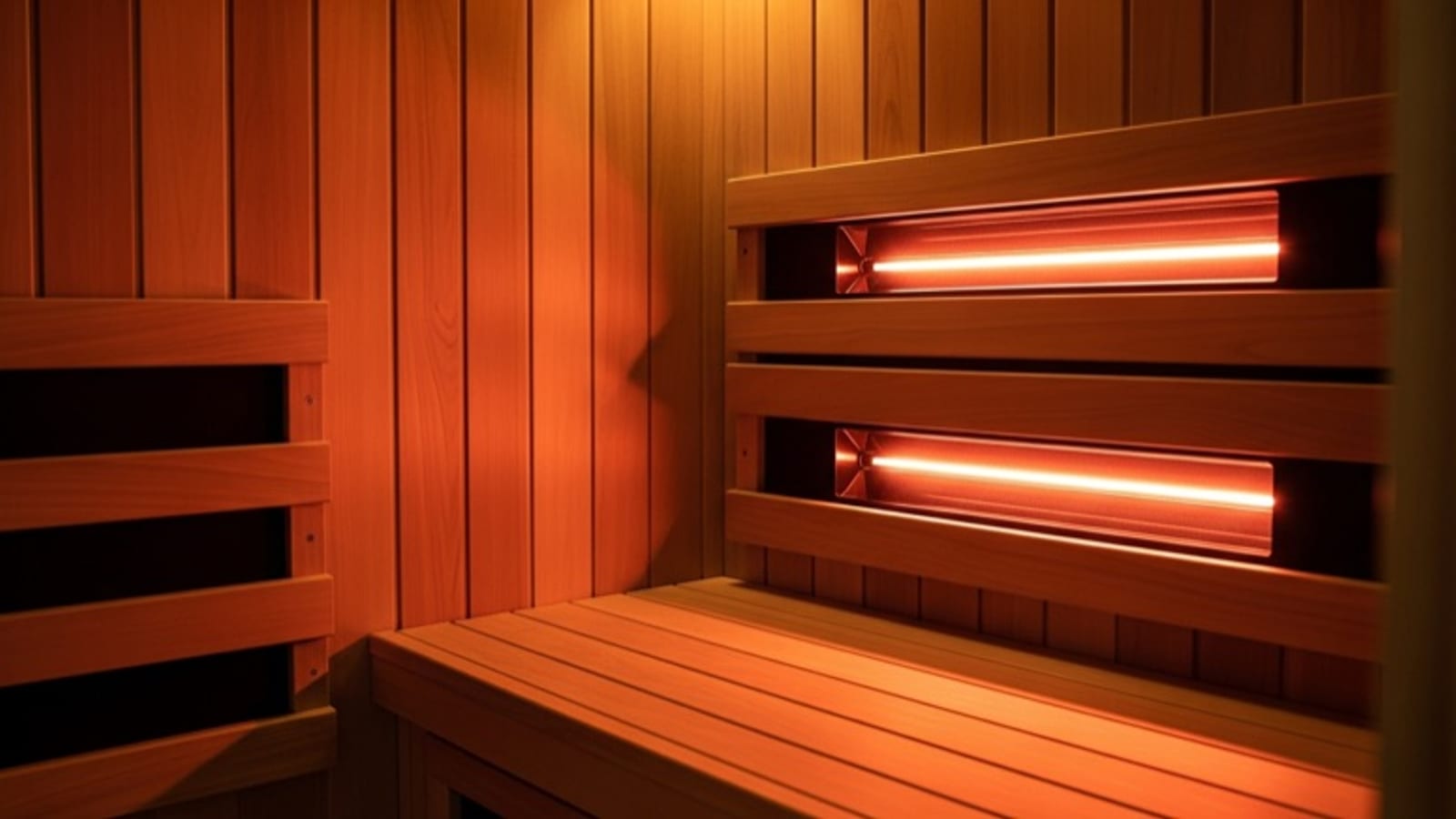
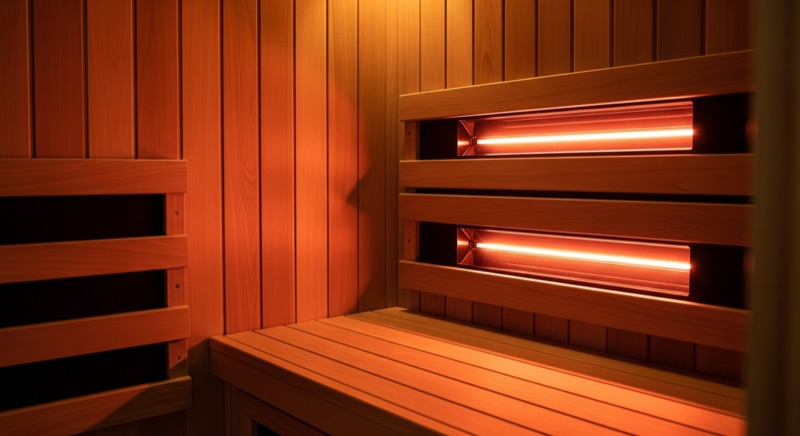
A ceramic emitter is a resistance wire embedded in or wound around a ceramic rod, tube or small plate, usually 2 to 4 inches across and 12 to 24 inches long, mounted behind a metal grille. Because the emitting area is small, the element has to run extremely hot to shed its rated wattage: surface temperatures of 500 to 700 degrees Fahrenheit are normal, and some tube designs go higher. That is a genuine point source. Stand a hand six inches from a working ceramic rod and you will pull it back.
A typical 2-person ceramic cabin carries 6 to 8 emitters totalling around 1,500 to 1,800 watts, which fits a dedicated 20 amp 120 volt circuit with headroom for the continuous load rule. The emitters cluster on the back wall and sometimes the side walls, which is why the back of your body gets most of the dose and your shins get very little.
Carbon fiber panels
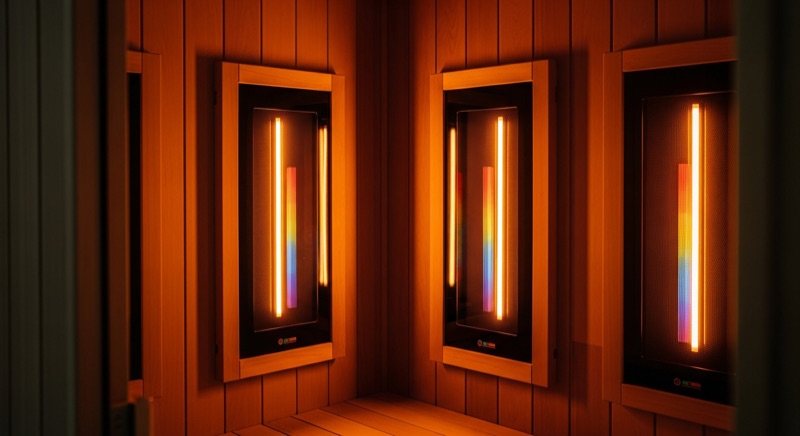
A carbon panel is a thin sheet of carbon fibre composite laminated between insulating layers, typically 12 to 24 inches wide and 30 to 48 inches tall. The same 1,500 to 1,800 watts spread across eight or ten of those panels means each square inch carries a fraction of the load, so the surface sits at only 150 to 200 degrees Fahrenheit. You can rest a palm on a running carbon panel and feel warm rather than burned.
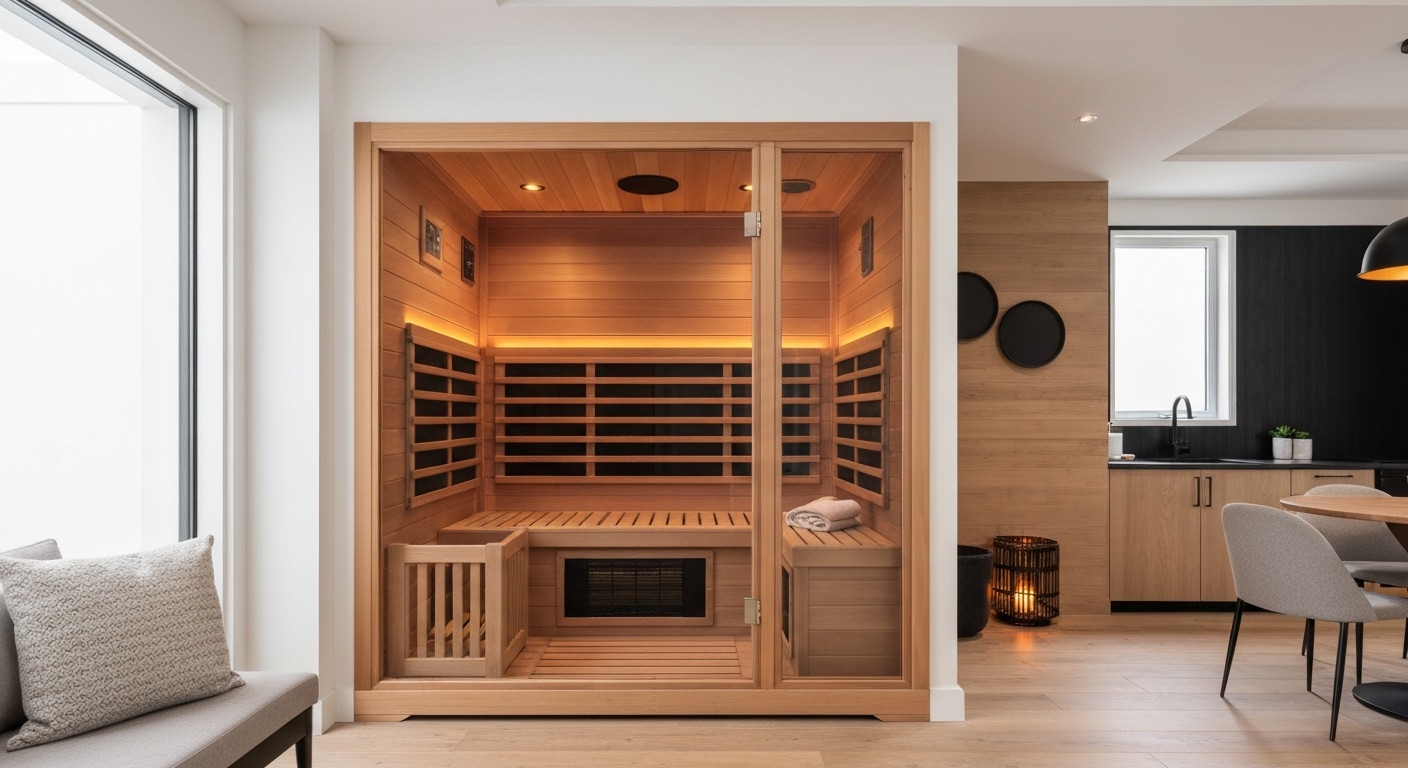
Because panels are large and flat, builders line the back wall, both side walls, the front wall beside the door, the floor and the calf area. Total emitting area in a well specified carbon cabin runs an order of magnitude above a ceramic build of the same wattage. That single fact drives every other difference below.
Wavelength, emissivity and why surface area beats watts
The peak wavelength a hot surface emits is set by its temperature. Wien's displacement law puts the peak at roughly 2,898 divided by the surface temperature in kelvin, in microns. A ceramic rod at 600 degrees Fahrenheit is about 589 K, which puts its peak near 4.9 microns. A carbon panel at 175 degrees Fahrenheit is about 353 K, with a peak near 8.2 microns. Both fall inside the far infrared band, so the popular claim that ceramic is not really far infrared is wrong, but the distributions are not the same shape.
The 9.4 micron figure brands quote is the peak of the human body's own thermal emission at normal skin temperature. Carbon lands closer to it. What that does and does not mean is where the marketing overreaches: water in tissue absorbs strongly across the whole range above about 3 microns, so neither element type is being reflected away. The practical consequence of carbon's longer, flatter band is comfort, not some resonance effect. If you want the wavelength question in more depth, our breakdown of near vs far infrared saunas covers where each band actually lands in tissue.
Emissivity is a smaller lever than most spec sheets suggest. Both ceramic emitters and carbon composites run around 0.90 to 0.95, so neither has a meaningful advantage in how efficiently its surface converts heat into radiation. Radiated power scales with area multiplied by the fourth power of absolute temperature, which is exactly why a small ceramic rod must run at 600 degrees to match what a large carbon panel achieves at 175. The number worth asking a brand for is total emitting square footage, not watts.
How many square feet of emitting surface does this cabin have, and which walls carry it? Two 1,700 watt saunas can differ by 5x in emitting area. The one with more area at a lower temperature will feel better for a 40 minute session even though the wattage on the label is identical.
Heat distribution and hot spots
This is where owners notice the difference within the first week. A ceramic cabin produces steep gradients. Sit with your back four inches from a rod and that patch of skin can feel uncomfortably intense while your knees, only two feet away, stay comparatively cool. The usual coping strategy is to lean forward, rotate, or drape a towel over the grille, all of which reduce the dose you paid for.
Carbon panels behave more like a warm wall than a heat lamp. The gradient across a seated body is much gentler, so you can lean back for the whole session without a hot patch on your shoulder blades. The trade is on the other side of the ledger: because the surface never gets very hot, the cabin air climbs slowly and the reading on the controller lags well behind how warm you already feel.
A useful rule for either type: check where the calf and front panels are. A ceramic sauna with nothing below the bench heats your back and leaves your lower legs out of the session entirely. A carbon sauna without front or floor panels has the same problem in milder form. Panel placement is a bigger comfort variable than element chemistry.
Heat-up time and energy use
Ceramic reaches the set point in roughly 10 to 15 minutes from cold. Carbon usually needs 25 to 40 minutes, and outdoor or garage installations in winter push that toward the top of the range. If you use the sauna on impulse after work rather than on a schedule, that difference is real and worth weighting.
It is also less decisive than it looks. Radiant heat reaches you as soon as the panels start climbing, so a carbon session can begin at minute five with the cabin still at 105 degrees, and you will sweat on schedule. What you are actually waiting for with carbon is the air temperature reading, not the therapeutic dose.
Running cost is close to a wash. Both types draw their rated wattage while the element is on and cycle off once the set point is reached. A 1,600 watt cabin at 0.16 dollars per kilowatt hour costs roughly 0.13 dollars for a 45 minute session if the duty cycle averages 50 percent. Ceramic burns more in the first ten minutes and then cycles harder; carbon draws more steadily for longer. Over a month of four sessions a week the gap is a couple of dollars, not a deciding factor. Our infrared sauna cost guide breaks the running numbers down further alongside purchase price.
EMF: the strongest argument for carbon
Nothing about ceramic as a material generates electromagnetic fields. EMF in a sauna comes from the current path: how the resistance wiring is routed, whether the outbound and return conductors are laid to cancel each other, and whether the assembly carries a grounded shield behind it. Carbon panels win here because a wide flat sheet gives designers room to do all three properly.
A ceramic rod concentrates the same current into a short, tightly wound element with dense connection points and a metal grille in front, which is harder to shield without cooking the shield. Budget ceramic cabins usually skip shielding entirely, and readings of several milligauss at the panel face are common on cheap units. Low EMF brands quote figures under 1 milligauss at the seated position, and essentially all of them build on carbon or carbon-based hybrid panels. If low field exposure is a priority for you, start with our tested picks for the best low EMF infrared saunas rather than trying to retrofit a ceramic cabin.
Two practical notes. First, a magnetic field reading falls off steeply with distance, so a number measured at the panel face and a number measured where your torso actually sits are very different claims. Always ask which one a brand is quoting. Second, ELF electric field is a separate measurement from magnetic field, and a sauna can score well on one and poorly on the other. Brands that publish both, with the measurement position stated, are the ones taking it seriously.
Durability, replacement cost and lifespan
Ceramic elements are commonly quoted at 3,000 to 5,000 hours of service. At four 40 minute sessions a week that is roughly 5 to 8 years before output starts to drop. Failures are usually a single rod going open circuit, and the symptom is one cold zone rather than a dead sauna. A replacement rod typically runs 40 to 120 dollars and a competent owner can swap one in half an hour.
Carbon panels are rated for longer, usually 10 years or more, and mid range and premium brands frequently back them with a lifetime element warranty because failure rates are low. The failure mode is a delaminated or cracked panel, which is harder to detect since a partially degraded panel just radiates less. Replacements are more expensive at roughly 150 to 400 dollars per panel, and they are brand specific, so a discontinued model can leave you without a supply.
There is a build quality point that outranks both. The most common real world failure in cheap saunas is not the element at all, it is the controller board, the thermostat probe or a connector. Check what the warranty covers on those parts before you weigh element lifespan.
What each type costs
Ceramic is cheaper to manufacture. The elements are simple, small, and produced in enormous volume, so ceramic dominates the shelf from roughly 800 to 2,000 dollars, which covers most 1-person and 2-person cabins sold on Amazon. If your budget is firmly in that band, you are choosing between ceramic units and a small number of thin carbon panel builds that cut corners elsewhere to hit the price.
Carbon starts around 1,500 dollars and runs through the mid and premium tiers to 6,000 dollars and beyond. Above roughly 2,500 dollars, carbon is effectively the default, and near enough every brand claiming low EMF or full spectrum uses carbon as the far infrared base. Shoppers working under 2,000 dollars should read our best budget infrared sauna picks, which flags the units where the savings come from cabinet materials rather than the heating system.
Carbon-ceramic hybrids: real or marketing?
Both exist. The genuine version puts two different element types in one cabin: large carbon panels on the walls for broad even coverage, plus a small number of higher temperature ceramic or halogen emitters positioned at the back, calves or feet for concentrated output. That is a defensible design, and you can verify it because the spec sheet lists each element type with its own wattage and location.
The weaker version is a carbon panel with a ceramic or ceramic-compound coating on its emitting face. This is not fake, it does raise emitting surface temperature and shifts the peak slightly shorter, but the effect is modest and rarely quantified. When the phrase carbon-ceramic appears as a product name with no wattage split and no element diagram, treat it as branding.
The distinction matters most on full spectrum units, where near infrared usually comes from a separate incandescent lamp rather than from either carbon or ceramic. If that is where you are heading, our guide to the best full spectrum infrared saunas explains which brands publish irradiance data and which just add an LED strip and call it near infrared.
Which should you buy?
- +You care about low EMF or someone in the household is sensitive to it.
- +Sessions run 35 minutes or longer and comfort matters more than speed.
- +You want even coverage across the whole body rather than a hot back.
- +Your budget clears roughly 1,500 dollars for a 2-person cabin.
- +The sauna lives indoors at a stable room temperature.
- +Your budget is under about 1,500 dollars and you want a real cabin, not a blanket.
- +You use the sauna on impulse and will not wait 30 minutes for warm-up.
- +The unit sits in a cold garage or basement that needs aggressive heating.
- +You prefer intense, concentrated heat on the back and shoulders.
- +Cheap individual element replacement matters more than a long warranty.
The verdict
Carbon is the better heating technology for a home infrared sauna, and the market agrees: every price tier above about 2,500 dollars is built on it. The reasons are structural rather than promotional. More emitting area at a lower surface temperature gives you even heat with no scorching zone, a spectral peak closer to the band the body itself radiates, an element that is straightforward to shield for low EMF, and a longer service life with a stronger warranty behind it.
Ceramic is not a bad choice, it is a cheaper one with a specific profile. If you are buying at 1,200 dollars, a well built ceramic cabin with proper wiring beats a corner-cutting carbon unit at the same price every time. Fast heat-up is a genuine benefit for anyone in a cold room or anyone whose sauna habit depends on low friction. Just go in knowing you will manage hot spots, and check the EMF reading at the seat rather than assuming.
The one thing not worth paying extra for is a hybrid badge with no numbers behind it. If a brand cannot tell you the wattage split between element types and where each one sits, the label is doing no work for you.