Near Infrared vs Far Infrared Sauna: What the Difference Actually Means
Far infrared is the heat source. Near infrared is the light therapy mechanism. They work differently, and most articles comparing them get this wrong. Here is what the wavelength distinction actually means for how you use a sauna.
FIR and NIR are not two versions of the same thing. They work through completely different mechanisms. FIR is thermal - it heats. NIR at therapeutic doses is photochemical - it stimulates without primarily heating.
The critical number most brands omit: therapeutic NIR photobiomodulation requires 50-100 mW/cm2 irradiance at skin surface. Most sauna NIR components deliver under 10 mW/cm2 at seated distance. This gap defines whether you are getting photobiomodulation or just a sauna with red-colored LEDs.
The infrared spectrum: three bands
Near Infrared (NIR)
700-1,400 nmMid Infrared (MIR)
1,400-3,000 nmFar Infrared (FIR)
5,000-15,000 nm (5-15 microns)Far infrared: the foundation of all sauna heat therapy
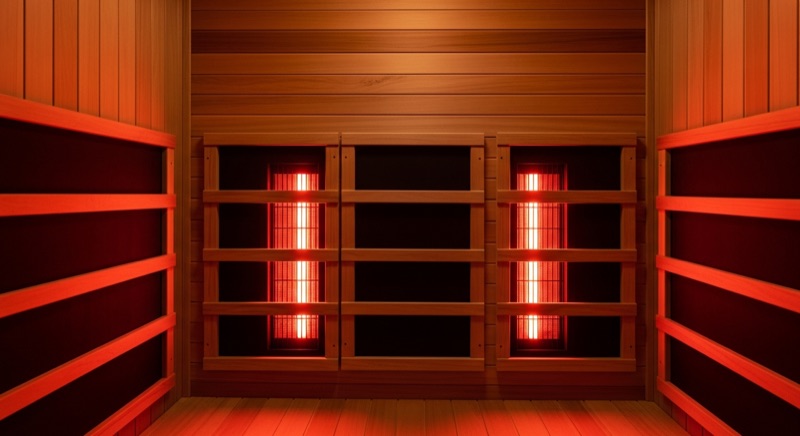
Far infrared spans 5-15 microns (5,000-15,000 nm). This is the emission band of all standard infrared saunas - carbon panels, ceramic panels, and heater rod systems all emit predominantly in FIR. The mechanism is thermal: FIR energy resonates with water molecules in biological tissue, causing them to vibrate and generate heat from within the body rather than heating the air first.
Penetration depth for FIR is several centimeters into soft tissue. This is deeper than conventional convective heat (hot air saunas), which heats primarily from the surface. The depth advantage is why infrared saunas can produce a comparable sweat response at lower air temperatures (120-150 F vs 170-200 F in a traditional sauna).
All of the well-documented sauna benefits - cardiovascular improvement, relaxation, pain modulation, post-workout recovery - are primarily FIR-mediated thermal effects. A standard FIR sauna is sufficient for these goals.
Near infrared: photobiomodulation, not primarily heat
Near infrared spans 700-1,400 nm. At therapeutic irradiance levels, NIR works through photobiomodulation (PBM) - a non-thermal mechanism. Photons in the NIR range are absorbed by cytochrome c oxidase, an enzyme in the mitochondrial electron transport chain. This absorption increases mitochondrial ATP production and triggers downstream anti-inflammatory and regenerative signaling.
The effects studied in PBM research include: improved collagen synthesis, reduced inflammation, improved wound healing, potential neuroprotective effects, and improved skin texture. These are distinct from the thermal effects of FIR.
Therapeutic photobiomodulation requires irradiance at skin surface of 50-100 mW/cm2 in the red/NIR range. A dedicated therapeutic red light panel at 6 inches delivers this. A sauna heater emitting some NIR at 18-24 inches seated distance typically delivers under 10 mW/cm2 NIR. This gap means that most "full spectrum" sauna NIR components produce heat alongside a sub-therapeutic NIR exposure - you may get a mild photobiomodulation stimulus, but it is not equivalent to a dedicated therapeutic panel at proper distance.
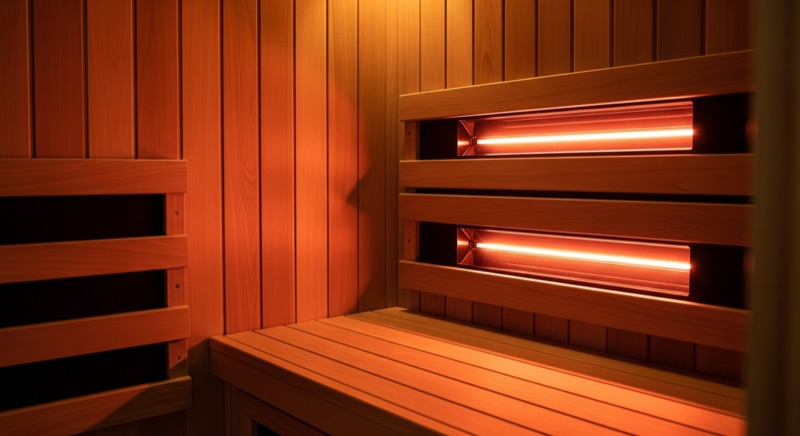
SaunaSpace uses incandescent heat lamps that emit a broad spectrum including substantial NIR, at close range. This is a different approach from carbon panel FIR plus LED NIR strips. Incandescent NIR at 12-18 inches may reach therapeutic irradiance thresholds. Sunlighten claims therapeutic NIR output and has some clinical research citing their specific product. These are the credible exceptions. Generic "full spectrum" LED additions to budget saunas are not in this category.
Practical recommendations by goal
What "full spectrum" actually means - and when to pay for it
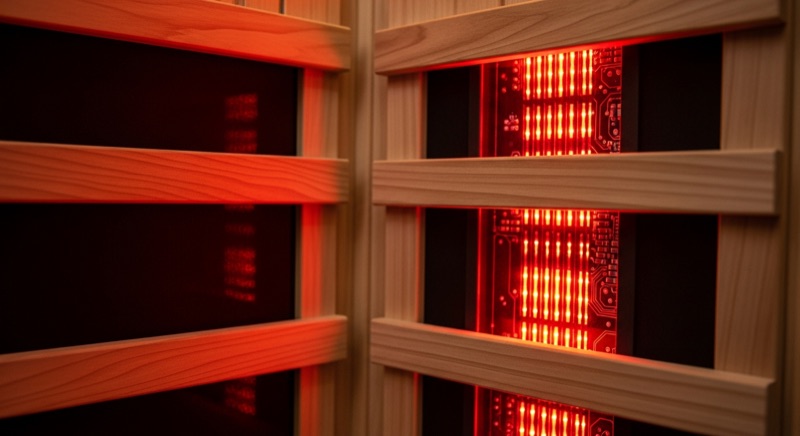
A full-spectrum sauna combines NIR, MIR, and FIR heating in one unit. In practice, different brands achieve this differently. Some use multiple heater types - incandescent lamps for NIR, carbon panels for FIR. Others add LED strips as a NIR add-on to a standard FIR heater.
The full spectrum premium is worth paying for only if the NIR irradiance is confirmed. Ask any brand: "What is the mW/cm2 irradiance at the seated position from your NIR component?" If they cannot answer with a specific number, you are paying for an unverified claim.
Brands that do publish this data include Sunlighten (clinical research references) and Sun Home (for their Eclipse model). Clearlight uses full-spectrum heaters but does not publish seated NIR irradiance figures. Generic budget saunas with LED strips fall at the bottom of credibility on this dimension.
NIR vs FIR at a glance
- +Standard in all infrared saunas
- +Heats body from within - deep tissue thermal effect
- +Primary driver of sweating, cardiovascular response
- +Sufficient for relaxation, recovery, pain goals
- +No irradiance threshold required - it is a heat mechanism
- +Available in every carbon or ceramic-panel sauna
- !Present in full-spectrum saunas and NIR lamp units
- !Non-thermal photobiomodulation at therapeutic doses
- !Stimulates mitochondrial ATP production
- !Requires 50-100 mW/cm2 at skin to be therapeutic
- !Most sauna NIR components deliver under 10 mW/cm2
- !Dedicated panels (PlatinumLED, SaunaSpace) are more reliable