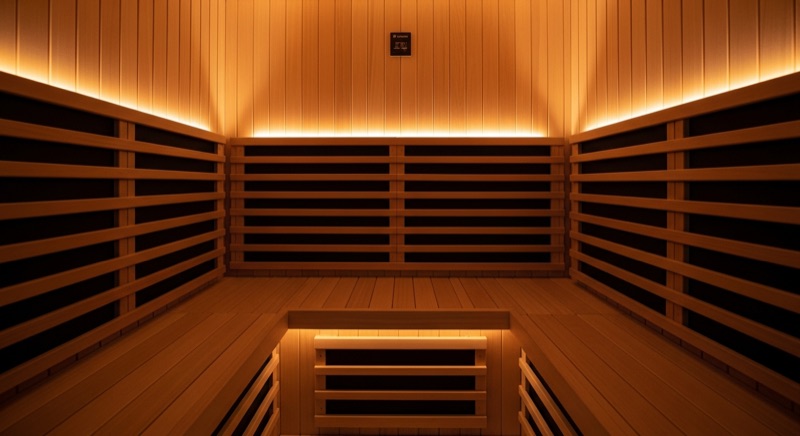
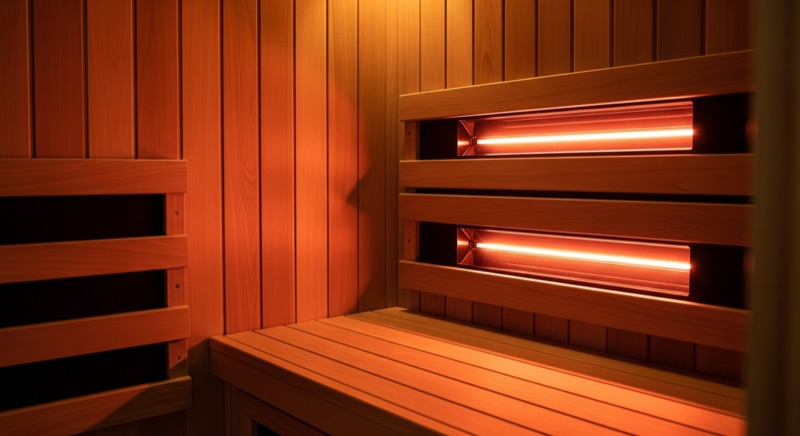
Infrared Sauna vs Red Light Therapy
The sauna industry has conflated these two therapies to the point of active misinformation. They use different wavelengths by a factor of 10-20x, target different biology, and produce different effects. One heats. One stimulates cells. Here is what is actually true.
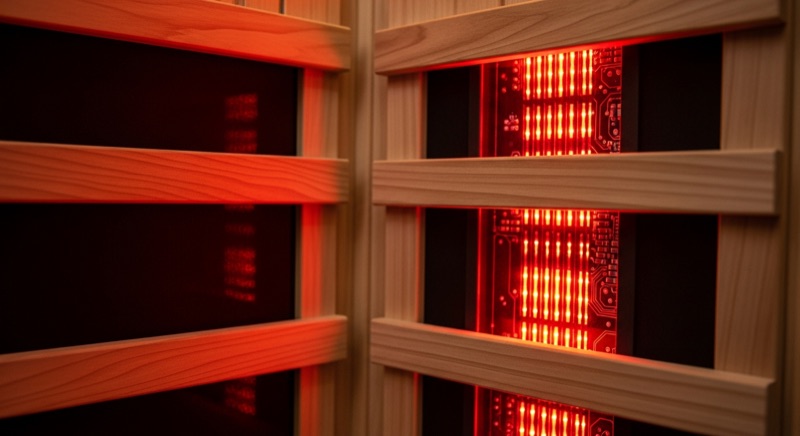
Far infrared sauna heaters emit 5,000-15,000 nm wavelength radiation. This resonates with water molecules in tissue, generating heat from within. It is a thermal therapy - the body temperature rises meaningfully.
Red light therapy (photobiomodulation) uses 630-700 nm red light and 700-1,100 nm near-infrared. These photons are absorbed by cytochrome c oxidase, a protein in the mitochondrial electron transport chain, stimulating ATP production. This is a non-thermal intervention - it works at energy densities that do not meaningfully heat tissue.
The word infrared appears in both names because both operate in the infrared portion of the electromagnetic spectrum - but they occupy completely different sub-ranges. Far infrared and near infrared are not interchangeable any more than AM radio and X-rays are interchangeable because both are electromagnetic radiation.
What each therapy is better at
- Cardiovascular adaptation through heat stress
- Sweating and thermoregulation practice
- Full-body deep relaxation and muscle release
- Post-exercise recovery through increased circulation
- Chronic pain relief via heat and vasodilation
- Targeted tissue repair and wound healing
- Collagen synthesis and skin quality
- Musculoskeletal pain without systemic heat
- Neurological recovery - traumatic brain injury research
- People who cannot tolerate heat therapy
Side-by-side comparison
The science behind each mechanism
Far infrared sauna: thermal biology
Infrared sauna heaters emit radiation in the far infrared band - roughly 5-15 microns (5,000-15,000 nm). At these wavelengths, photons are too low-energy to cause photochemical reactions in cells. Instead, they are absorbed by water molecules throughout tissue, causing them to vibrate and generate heat. The effect is essentially internal heating - the body heats from within rather than purely from hot air surrounding it.
The result is a thermal response: core body temperature rises, the cardiovascular system responds with vasodilation and increased cardiac output, sweat glands activate, and metabolic rate increases. This is the same heat stress response produced by traditional sauna or vigorous exercise, generated by a different mechanism. The clinical benefits attributed to infrared sauna - pain relief, cardiovascular adaptation, improved circulation - are primarily thermal biology, not photobiology.
Red light therapy (photobiomodulation): cellular signaling
Red light therapy, also called photobiomodulation (PBM) or low-level laser therapy (LLLT), uses visible red light (630-700 nm) and near-infrared light (700-1,100 nm). These shorter wavelengths have enough photon energy to cause photochemical reactions without generating significant heat.
The primary target is cytochrome c oxidase (CCO), Complex IV of the mitochondrial electron transport chain. CCO absorbs photons at these wavelengths, which appears to reverse inhibition by nitric oxide and increase the efficiency of ATP production. The downstream effects include increased cellular energy availability, upregulation of anti-inflammatory pathways, increased collagen synthesis in fibroblasts, and enhanced cellular repair processes.
The evidence base for photobiomodulation is substantial: hundreds of randomized controlled trials across wound healing, musculoskeletal pain, neurological applications (including traumatic brain injury), and skin quality. The mechanism is well-characterized at the molecular level. The dose-response relationship is clear - therapeutic effects require 50-100 mW/cm2 at skin surface, with optimal session duration of 10-20 minutes depending on tissue depth and body area.
Why the confusion exists
Modern infrared sauna heaters - particularly full-spectrum units - produce radiation across multiple infrared bands, including some near-infrared output (700-3,000 nm range). This near-infrared from the heater is accurately described as near-infrared radiation. Sauna manufacturers picked up on the photobiomodulation research and began marketing their heater's incidental NIR output as red light therapy benefits.
The problem is irradiance. Therapeutic photobiomodulation requires 50-100 mW/cm2 at the skin surface. Infrared sauna heaters at typical seated distances from the panel deliver incidental NIR irradiance well under 10 mW/cm2 - an order of magnitude below the therapeutic threshold. The radiation exists. The therapeutic irradiance does not.
Combination units: which ones actually deliver therapeutic PBM
A small number of products attempt to deliver both therapies simultaneously at clinically meaningful levels. The critical question is always irradiance - not what wavelengths are present, but at what power density they reach the body.
Practical use: how to actually get both benefits
Option 1: two separate devices
A quality infrared sauna (Dynamic, Clearlight, JNH, or similar) plus a dedicated red light therapy panel (PlatinumLED BioMax 450 or Joovv Solo 3.0) used separately gives you both therapies at verified therapeutic levels. This is the approach with the strongest evidence base: your sauna delivers real heat stress and your red light panel delivers documented irradiance. The downside is cost and space - two devices, two purchases.
For the red light session: stand or sit 6-12 inches from the panel for 10-20 minutes per body area. For the sauna: follow your normal session protocol. Many practitioners use red light therapy before a sauna session - red light first while the sauna heats up, then the sauna session itself.
Option 2: verified combination unit
The Sun Home Eclipse 2-person sauna and the PlatinumLED SaunaMAX PRO add-on panel are the two products with the most credible claims to delivering therapeutic irradiance inside a sauna environment. If buying new and wanting both in a single setup, the Eclipse is the most comprehensive option - but verify the irradiance specifications directly with the manufacturer before purchase. Request the mW/cm2 figure at seated body position and the measurement method used.
Advantages and limitations of each approach
Infrared sauna
Red light therapy
Verdict
These are not competing therapies - they are different interventions for different biological pathways. Comparing them as if you must choose one misses the point. The relevant question is: what are you trying to achieve?
For heat therapy, cardiovascular adaptation, sweating, and whole-body relaxation: infrared sauna is the correct tool. Red light therapy cannot replicate the heat stress response.
For tissue repair, collagen synthesis, targeted musculoskeletal pain, or conditions where heat is contraindicated: a dedicated red light therapy panel with documented irradiance is the correct tool. An infrared sauna does not deliver therapeutic photobiomodulation unless it has verified panel irradiance at seated position.
If you encounter sauna marketing claiming red light therapy benefits: ask for mW/cm2 at seated body position. Anything under 50 mW/cm2 is sub-therapeutic for PBM regardless of the wavelengths present. This one question separates honest specification from marketing language.