Infrared Sauna Not Heating Up? A Step-by-Step Fix Guide
Most infrared saunas that seem not to heat are either working normally or have a simple fault: a tripped breaker or GFCI, a loose heater connector, or a temperature sensor that switches the heaters off early. A healthy cabin usually reads 115 to 140 F after 30 to 60 minutes, never the maximum on the dial. Work through the checks below in order, safest first, and stop at anything that means opening the power supply.
- 01Air temperature lags the heaters: Dynamic lists about 20 minutes to 100 F and 45 to 60 minutes to about 135 F from a 70 F room.
- 02The top of the dial is not a target. Dynamic and Clearlight both say their cabins never reach it.
- 03A cold room lowers the top temperature. A 40 F garage can cap a cabin near 105 to 110 F (an estimate from heat-loss physics).
- 04One cold panel is usually a loose connector. Reseat it only with the sauna unplugged.
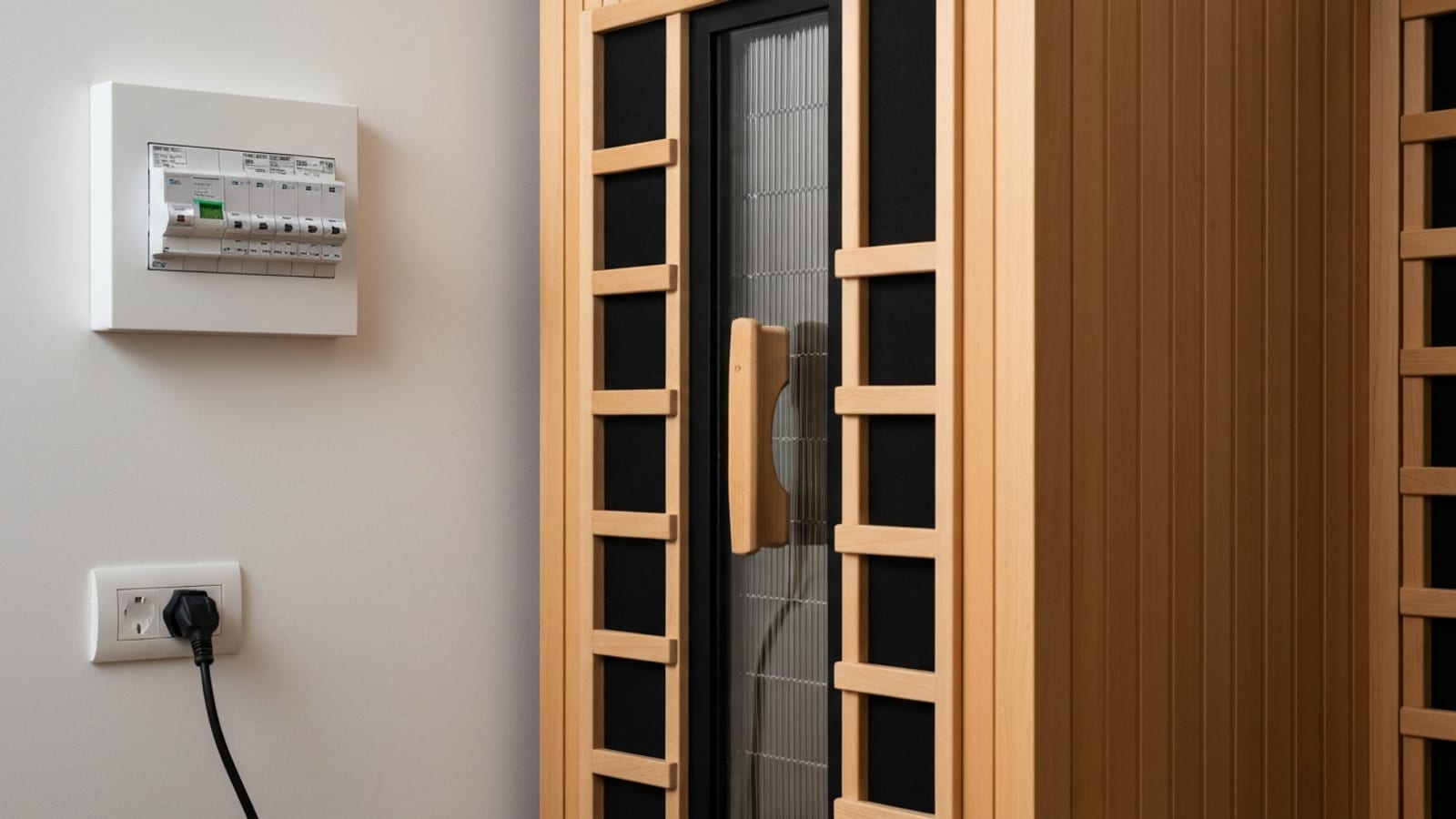
- 05A breaker or GFCI that trips again after one reset is a fault. Never bypass it, and never use an extension cord.
First, Check Whether It Is Actually Broken
An infrared sauna heats you before it heats the air, so a slow display is not proof of a fault. The panels warm skin directly, while the cabin air warms slowly from the panel surfaces and from your body. The display shows air temperature at one sensor, the last thing in the cabin to catch up. Manufacturers publish real warm-up numbers, and those are the baseline to judge against.
| Source | Warm-up it states | What the air does |
|---|---|---|
Dynamic (Golden Designs) manuals | ~20 min to 100 F from a room above 70 F; 25-30 min to 115-120 F; 35-40 min to 125-130 F; 45-60 min to about 135 F | Most common setting 118-122 F; heats about 1.5 F per minute in a 70 F room, slower in a colder one |
Health Mate Inspire manual | 15-20 min to a 110-120 F base temperature, on every series | Sessions usually 120-140 F; the maximum setting may not be reached in some rooms |
Clearlight first-use guide | Warm up 10-15 min, then set the thermostat to 150-175 F | Air ranges 115-125 F and will not reach the set figure |
Sunlighten first-timer guide | Allow 45-60 min | About one degree per minute, depending on room temperature |
Quoted from the manuals and first-use guides under Sources, for those models. Check your own manual.
The working rule: if the cabin passes about 100 F within 20 to 30 minutes in a normally heated room and keeps climbing into the 120s or 130s within the hour, the heaters work. Stuck below 100 F after 30 minutes means something is wrong.
Why 120-140 F on the display is normal
Three things hold the reading below the dial. Heat leaks out of a thin wooden box with vents and a glass door until loss matches input. The thermostat cuts the heaters at the set point: Dynamic's manual describes the HEAT light going off while WORK stays on, with heat returning after a drop of about 4 F. And the top setting is out of reach on purpose. Dynamic allows 150 to 151 F and says the room will never get there; Clearlight tells owners to set 150 to 175 F so the heaters stay on and expects 115 to 125 F air. A cabin set to 140 F that settles at 128 F is most likely at its normal top temperature.
Cold garages, basements and outdoor cabins
Room temperature sets both the speed and the top temperature. Dynamic's Barcelona manual quotes about 1.5 F per minute in a room of 70 F or warmer and slower below that. Health Mate warns its maximum setting may not be reached because of ambient temperature, air flow and placement, and offers thermostat calibration help when warm-up times look unusual.
The physics is simple. With the heaters flat out, a cabin settles where heat in equals heat out, and heat out grows with the gap between inside and outside, so the achievable rise above room temperature is roughly fixed. A cabin that tops out near 140 F in a 70 F room may stall around 105 to 110 F in a 40 F garage. That is our estimate, not a manufacturer figure. Preheat longer, keep the door shut, stop drafts, and see our guide on where to put an infrared sauna for garage and basement placement.
Not heating, or just not sweating?
If the display reaches the 120s and the panels feel warm but you are not sweating after 15 minutes, the sauna is working. The cause is session length, hydration or distance from the panels, covered in our guide to not sweating in an infrared sauna.
What Not to Do While Troubleshooting
Most heating faults are found with the sauna unplugged and a flashlight. The rest belong to an electrician or the manufacturer, and the manuals are blunt about where that line sits.
- xDo not open the power supply or control box. Health Mate says it has no user-serviceable parts inside, and altering its connections voids the warranty.
- xDo not bypass a GFCI or a high-limit control. UL 875, the safety standard for electric dry-bath heaters, requires a manual-reset limit control; a trip means something overheated.
- xDo not use an extension cord, plug adapter or surge strip. Dynamic's manual rules out all three.
- xDo not keep resetting a breaker that trips again straight away. Each reset feeds current back into the fault.
- xDo not grab ceramic or quartz heaters to test them; they run far hotter than carbon panels.
- xDo not handle plugs or connectors with wet hands or wet feet.
Switch off at the breaker, not just the control panel, and call the manufacturer or an electrician before the next use. The wood and glue smell of a new cabin is different, see infrared sauna off-gassing. An electrical burning smell is never part of a break-in.
The Diagnostic Order: Cheapest and Safest Checks First
Work down the list in order. Each step finds the problem or rules out a whole category, and the first four need no tools.
If the display is dark, push the cord fully into the outlet and the sauna's inlet, then plug a lamp into that outlet, as Health Mate's manual suggests. No power there means a breaker or an upstream GFCI, possibly in a garage, bathroom or basement. If the outlet is live, press the reset buttons on the sauna's power supply once: Health Mate has two, and Dynamic has one on the roof unit beside the power cord.
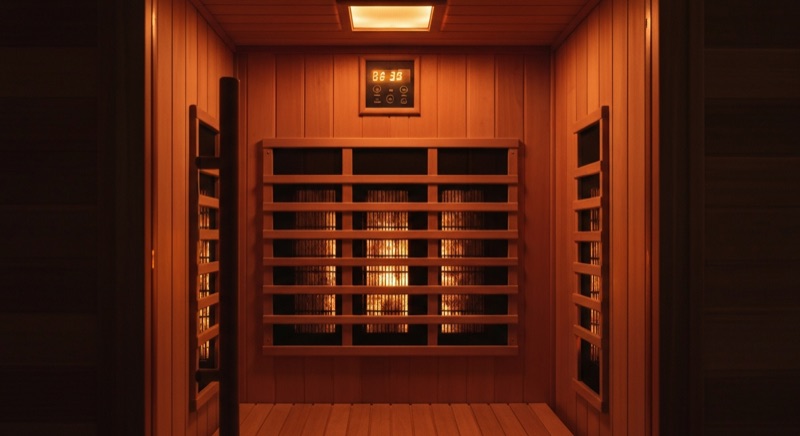
A lit display with cold panels is often a setting. Check the timer (Health Mate's Inspire stops at 60 minutes), that heating is on (its logo key glows red when heating, green when idle), and that the set point is above the current reading. On Dynamic units, changing the time mid-session stops the heaters until you press START twice.
Make sure the door latches and its seal is intact, because a door resting slightly open bleeds heat all session. Set adjustable vents the way your manual specifies for warm-up, and do not open the door to check progress.
A disconnected or damaged sensor usually stops heating outright. Dynamic controllers show -L or EP; Health Mate's beeps and shows an error when the sensor inside the control panel housing comes unplugged. Look the code up in your manual.
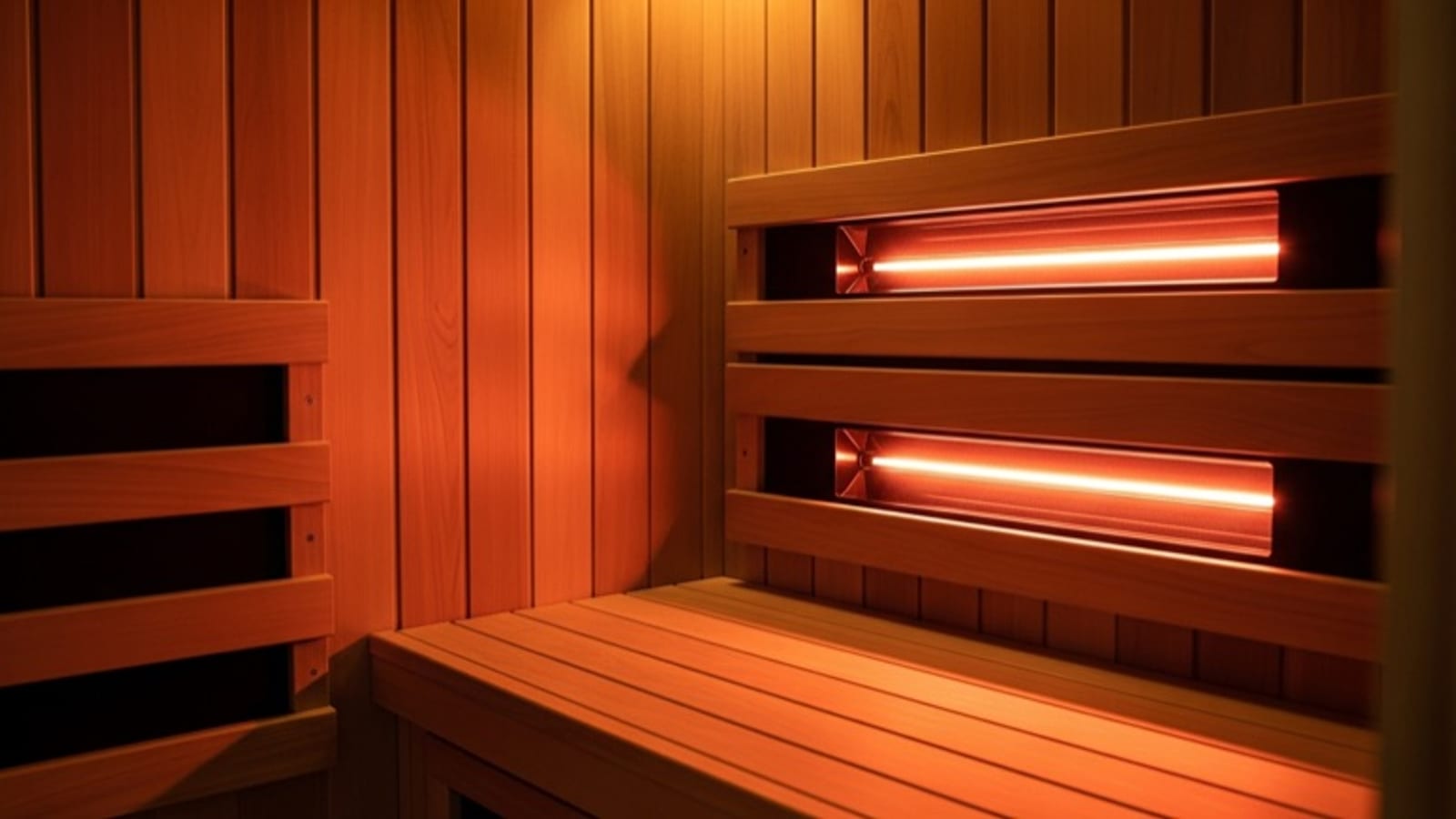
Run the sauna for 10 to 15 minutes with the door shut, then check each heater. Carbon panels should feel clearly warm through the fabric; hold a palm near ceramic or quartz elements instead of touching them, and quartz tubes glow when working. Bench and floor heaters run cooler by design: Dynamic's 1-2 person cabins pair 300 W wall emitters with a 200 W bench emitter and a 125 W floor emitter.
Unplug at the wall first, then reseat every heater connection firmly. Dynamic's heater cords run to labelled ports (HT1 to HT6) on the roof power supply, with the bench emitter on an inlet in the rear wall. Health Mate sends front-heater faults to a blue Molex connector low on the right as you sit on the bench, keyed with two rounded pins and one square one. Then repeat step 5.
If a panel is still cold and your manual or support team approves it, swap its plug with a working panel's plug at the power supply, power off. If the cold spot moves, the port is at fault. If it stays put, the panel is.
Run the 90-minute log test
If every panel feels warm but the cabin still underperforms, copy the test in Dynamic's manual. Remove the bench, set maximum temperature and 90 minutes, note the starting temperature, and write down the display reading every 15 minutes with the door shut. From a start above 70 F, its 1-2 person cabins should pass 130 F, usually within 40 to 50 minutes; with even one emitter not working, the manual says the cabin will struggle to get above 130 F. Keep the log for a warranty claim.
Why sensor position changes everything
The temperature sensor decides when the heaters stop, and on most cabins it is a probe hanging vertically from the ceiling above the bench, as Dynamic's assembly instructions specify. Hot air stratifies, so the ceiling is the warmest spot and the controller judges the room by it: the heaters can stop while your legs still feel cool. They also cycle off early if the probe is pushed flush into the ceiling, sits near a heater or light, or has a towel hung near it. Put it back where the manual shows. If the cabin hits the set point fast and spends most of the session with HEAT off, raise the set point, as Dynamic and Clearlight both advise.
When it is the heater itself: carbon vs ceramic
If reseating and swapping both point to one panel, it has most likely failed. Ceramic and quartz elements tend to fail open, leaving one rod cold and sometimes visibly cracked. Carbon panels usually fail at a solder joint or terminal, or degrade and radiate less, which only the log test reveals. Our carbon vs ceramic heater comparison covers how each type works and what replacements cost. Dynamic's manual is explicit: a damaged emitter means you stop using the sauna and get the part from the manufacturer.
Breaker or GFCI Keeps Tripping
The timing tells you most of it: a delayed trip points to load, an instant trip points to a fault, and a GFCI trip is its own case.
Trips after several minutes
A breaker that holds and then trips is usually overloaded. A sauna draws close to its full rating for the whole session, so a hair dryer or space heater on the same circuit pushes it over. Health Mate says to check that the breaker matches the sauna's rating (its Inspire 2 is 120 V 15 A, the Inspire 3 needs 120 V 20 A) and that the circuit is not overloaded, then to call an electrician. Dynamic accepts a dedicated line or one where nothing else draws power during sessions. Circuit sizing is covered in our infrared sauna electrical requirements guide; the troubleshooting step is to unplug everything else on that breaker and try again.
Trips instantly
A trip the moment the heaters engage points to a short in a cord, a harness, a panel or the power supply. Reset once; if it trips again, leave it off. Finding the shorted part means powering up with panels disconnected one at a time, which is work for the manufacturer's technician or a licensed electrician.
GFCI trips, and why heaters cause them
A GFCI cuts power when the current going out and the current coming back differ. Under the National Electrical Code definition, a Class A GFCI must trip at 6 mA and must not trip below 4 mA. Every heating element leaks a little current to ground through its insulation, and six or eight panels plus some moisture can add up to a few milliamps.
Manufacturers disagree on what to do about it. Dynamic says its saunas cannot be connected to a GFCI and describes GFCIs that worked for months and then began tripping. Health Mate strongly recommends a GFCI in potentially wet locations. Recent NEC editions require GFCI protection for most receptacles in home garages, basements, bathrooms and outdoors, which is exactly where many saunas sit. Let your electrician and the manufacturer settle that conflict together. Never swap the GFCI for a standard receptacle, and treat new tripping on a sauna that used to run fine as a sign of moisture, a degrading panel or a worn GFCI that an electrician can measure.
Hot plug, scorched outlet or low voltage
A plug too hot to hold, or brown marks around the outlet, mean a loose terminal. Dynamic's manual says to stop using the sauna and have an electrician replace the outlet. Low voltage is quieter. Heater output scales with voltage squared, so a 240 V cabin on a 208 V apartment or commercial supply gives about 75 percent of its rated heat, and a 5 percent drop along a long run costs about 10 percent. The fix is a supply that matches the rating plate, not a higher setting.
Sauna Shuts Off by Itself
A sauna that switches itself off mid-session is usually doing what it was designed to do. Work out which of these you are seeing:
- 01The timer ended. Health Mate's Inspire controller stops at 60 minutes.
- 02The thermostat reached the set point. The heaters pause while the display stays on.
- 03A run-time limit kicked in. Dynamic requires a one-hour rest after three hours of continuous use.
- 04An over-temperature limit tripped. UL 875 requires a manual-reset limit, and Dynamic's Barcelona shows H when the cabin is too hot, with instructions to switch off and call the manufacturer. Repeated trips are a fault.
- 05The power supply protected itself. If its reset buttons keep popping, call the manufacturer.
Symptom, Likely Cause, What to Check
Find your symptom and go straight to the likely cause. Anything past a plug, a breaker, a reset button or a heater connector goes to the manufacturer or a licensed electrician.
| Symptom | Likely cause | What to check | DIY or call |
|---|---|---|---|
Display dark | No power, upstream GFCI, power supply tripped | Lamp in the outlet, breaker, nearby GFCIs, power supply reset | DIY |
Display on, no heat | Timer, heat off, low set point, sensor error | Settings, codes such as -L or EP | DIY, then manufacturer |
One panel cold | Loose heater cord or failed panel | Reseat with power off; port swap if approved | DIY, manufacturer for the panel |
Bench or floor heater lukewarm | Usually normal: lower wattage | Wattages in the manual | No action unless cold |
Stalls at 100-115 F | Cold room, door or vent leak, weak panel | Room temperature, door seal, 90-minute log | DIY, then manufacturer |
Takes well over an hour | Cold room, low voltage, extension cord | Cord, supply voltage against the rating plate | DIY; electrician for voltage |
Heaters cycle off early | Ceiling sensor reads hot air or a heat source | Probe position; raise the set point | DIY |
Breaker trips after minutes | Overloaded or shared circuit | Other loads; breaker size against the label | DIY to unload, electrician to fix |
Breaker trips instantly | Short in a cord, harness, panel or power supply | Reset once only | Electrician or manufacturer |
GFCI trips | Heater leakage, moisture, worn GFCI | When it trips; is it new? | Electrician and manufacturer |
Shuts off mid-session | Timer, run limit, over-temperature limit | Timer, H code, reset buttons | Manufacturer if a limit trips |
Hot plug, scorch marks, burning smell | Loose terminal, damaged cord, overheating part | Switch off at the breaker | Electrician and manufacturer, now |
Before You Call: Documenting a Warranty Claim
Most heater, sensor and power supply faults on a young sauna are warranty items, so handle them the way the warranty expects. Health Mate's manual says unauthorized repairs or altered power supply connections void the warranty, and that timely registration is required for a claim; Dynamic says the same about unauthorized repairs. Diagnose, document, and let the manufacturer authorize the fix. Send:
- +Model, serial number and proof of purchase. Health Mate puts the label next to the DATA and HEATER sockets at the bottom of the front panel.
- +Which heater is cold, by position: back wall left or right, side wall, bench or floor.
- +Photos or video of the display, any error code, the power supply ports and the connector you reseated.
- +Your temperature log: starting room temperature and the reading every 15 minutes.
- +The electrical picture: breaker size, dedicated or shared circuit, any GFCI, and exactly when it trips.
Out of warranty, the same record tells you whether a part is worth buying. Our guide to how long infrared saunas last covers warranty terms by price tier and the point where a repair stops making sense.
FAQ
Why is my infrared sauna not getting hot enough?+
How long should an infrared sauna take to heat up?+
Why is one panel in my infrared sauna not heating?+
Why does my infrared sauna keep tripping the GFCI?+
Can I run an infrared sauna on an extension cord?+
Why does my infrared sauna shut off by itself?+
- Dynamic DYN-6103-01 / DYN-6203-01 / DYN-6203-02 FS 1 & 2 Person Far Infrared Sauna Owner's Manual. Golden Designs Inc..
- Dynamic DYN-6106-01 / DYN-6106-01 Elite 1-2 Person Sauna Owner's Manual. Golden Designs Inc..
- Inspire 2 & Inspire 3 (Pin-Lock) Owner's Manual. Health Mate Sauna.
- Using and Enjoying Your New Clearlight Infrared Sauna. Clearlight Saunas.
- First Timers Guide to Sitting in a Sauna. Sunlighten.
- UL 875, Standard for Electric Dry-Bath Heaters (Edition 10). UL Standards & Engagement, 2024.
- NFPA 70, National Electrical Code. National Fire Protection Association.
We do not run a test lab. Figures on this page come from the sources above, from published manufacturer specifications, or are reasoned estimates that are labelled as such.