Infrared Sauna vs Dry Sauna
A dry sauna heats the air around you to 160-190 F with an electric or wood-fired rock heater. An infrared sauna heats your body directly with radiant panels, so the cabin only needs to sit at 120-150 F to produce a similar sweat. Both are dry heat, which is exactly why the two names get tangled. Below: the ambiguity resolved, a full spec table, the physiology of radiant versus hot-air heating, and buying rules by scenario.
A dry sauna, as most people use the phrase, is a traditional hot-rock sauna run without water on the stones: 160-190 F, 5-15% humidity, heat carried to you by hot air. An infrared sauna is a different machine that reaches you with radiant energy instead of hot air, so it runs at 120-150 F and still produces a comparable sweat over a longer session. Both are technically dry heat saunas, which is the source of most of the confusion.
Traditional dry heat suits people who want maximum thermal intensity per minute, the option of steam, and the deepest research base. Infrared suits people who want longer, gentler, far cheaper sessions they will actually do four or five times a week, in a cabin that plugs into a normal outlet.
Two different questions hide inside the phrase "dry sauna"
Almost every article on this topic skips past the actual problem, which is that "dry sauna" means two things and the comparison changes depending on which one you have in mind. Sort that out first and the rest of the page becomes straightforward.
Most people typing infrared sauna vs dry sauna are on reading 1: they picture a hot wooden room with rocks on a heater and want to know how an infrared cabin stacks up against it. People searching dry heat sauna or infrared dry sauna are usually on reading 2: they are checking whether an infrared sauna counts as dry at all. Both readings are answered below.
Reading 1: dry sauna means a traditional rock sauna with no water on the stones
In sauna terminology, dry refers only to humidity. A traditional Finnish sauna can be used two ways: with water thrown on the heated stones to create steam (called loyly in Finnish), or without water - producing purely dry heat. When used dry, it is called a dry sauna. This is not a different type of sauna - it is the same stone-heated Finnish sauna, simply operated without adding steam.
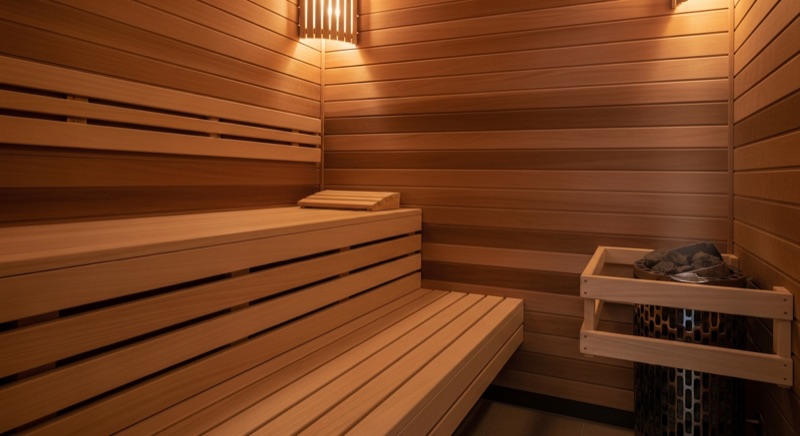
In American gyms and hotels the phrase has drifted a little further: the dry sauna is the wood-lined hot room next to the steam room, usually an electric heater at 170-190 F that nobody is allowed to pour water on. That is still the same machine, just run permanently in dry mode. If this is the sauna you mean, the comparison you want is the temperature, cost, and installation table further down, and our fuller infrared vs traditional sauna breakdown covers the wet-capable version of the same unit.
Reading 2: an infrared sauna is itself a dry heat sauna
Technically, yes. An infrared cabin sits at 10-20% relative humidity with no water source and no way to raise it, which puts it firmly in dry heat territory. Anyone telling you an infrared sauna is not a dry sauna is using dry as shorthand for traditional, which is a habit rather than a definition. So if the question is whether infrared counts as dry heat, the answer is that it counts twice over: there is no steam, and there is not even much hot air.
What actually separates them is delivery, not dryness. A traditional dry sauna heats the air and lets the air heat you. An infrared sauna skips the air and heats you directly, which is why its thermostat reads 40 degrees lower for a session that ends with a comparable amount of sweat on the floor. Humidity is the wrong axis to compare them on. Temperature and heat delivery are the right ones.
So what counts as a dry heat sauna?
Anything under roughly 25% relative humidity. That category holds both units on this page: traditional at 160-190 F and 5-15% humidity, infrared at 120-150 F and 10-20%. The thing it excludes is a steam room, which runs at roughly 110-120 F and 100% humidity and works on a completely different principle, condensation on the skin rather than evaporation from it. If you are weighing dry heat against wet heat rather than against another dry option, start with infrared sauna vs steam sauna instead.
Quick verdict: which type suits your situation
- You want the strongest cardiovascular research behind your sessions
- You want the option to add steam (loyly) in the same unit
- High-heat intensity is the point - you want to feel challenged
- You have a dedicated room or outbuilding for it
- Heat acclimatization for athletic performance is a goal
- Daily use and fast heat-up matter more than session intensity
- You have chronic pain, fibromyalgia, or heat sensitivity
- You live in an apartment and need a plug-and-play solution
- Low running cost ($2-5/month vs $12-18) is important
- You want a unit assembled in under 90 minutes with no construction
Full comparison: dry sauna vs infrared sauna
Now that the terminology is clear: here is a direct comparison of a traditional sauna used dry (no steam) versus an infrared sauna. These are the numbers that actually matter for a buying or usage decision.
How each type heats the body
Dry (traditional) sauna: convective heating
A traditional Finnish sauna heats the room air using a kiuas - a stone heater fueled by electricity or wood. Temperatures reach 160-190 F. The hot air surrounding the body heats the skin surface, which then drives heat into deeper tissue through conduction. Core body temperature rises. The cardiovascular system responds with vasodilation and increased cardiac output to dissipate heat. Sweating begins within the first few minutes.
Used dry - without throwing water on the stones - the relative humidity stays at 5-15%. This makes the high temperatures more tolerable than they would otherwise be in a humid environment. At 175 F and 10% humidity, the experience is intense but manageable for most healthy adults. At 175 F and 60% humidity, it becomes significantly more physically demanding.
Infrared sauna: radiant heating
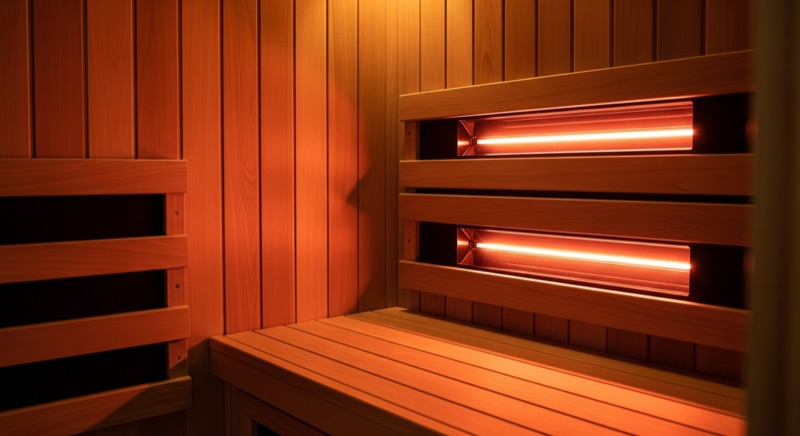
Infrared heaters emit radiation in the far infrared spectrum (typically 5-15 microns / 5,000-15,000 nm). This radiation is absorbed directly by water molecules in body tissue, creating heat within the tissue rather than heating the surrounding air first. The result is that the body can reach its heat-stress response at a lower cabin air temperature - typically 120-150 F - because the heat source is working directly on tissue rather than having to heat through the air and skin layers in sequence.
The humidity in an infrared sauna is 10-20% - slightly higher than a dry traditional sauna but still firmly in dry-heat territory. There is no mechanism to add steam, and no loyly experience available.
Health evidence: what the research supports
Traditional (dry) sauna: the strongest evidence base
The most significant cardiovascular evidence in heat therapy research comes from traditional Finnish sauna. Laukkanen's 20-year cohort of 2,315 Finnish men found that those using sauna 4-7 times per week had a 63% lower rate of sudden cardiac death compared to once-weekly users. The dose-response relationship held across the cohort - more frequent use correlated with greater risk reduction.
This data comes from Finnish men using traditional stone saunas at 160-180 F. The sessions that produced this data were dry sauna sessions - Finnish sauna culture involves both steam and no-steam use, but the cohort data reflects typical Finnish sauna practice, which is often used at high temperatures whether steam is added or not. The mechanistic pathway is thought to involve repeated cardiovascular adaptation to heat stress.
Infrared sauna: solid evidence for pain and accessibility
Infrared sauna's evidence base is strongest for chronic pain conditions. Multiple controlled trials have found meaningful pain and stiffness reduction in fibromyalgia patients after repeated infrared sessions. A 2009 Japanese study of heart failure patients found improvements in functional capacity and cardiac output after a series of far-infrared sessions - but this was a clinical population under medical supervision, not a broad healthy-adult study.
For healthy adults seeking cardiovascular protection comparable to the Laukkanen findings, the infrared evidence is weaker - not because infrared is ineffective, but because the large long-term studies simply have not been done yet. The plausible mechanism exists (heat stress promotes cardiovascular adaptation regardless of source) but the confirming data does not.
Practical considerations
Temperature and session experience
The 30-40 degree F difference between a dry traditional sauna (160-190 F) and an infrared sauna (120-150 F) is significant in practice. A traditional dry sauna at 175 F is a demanding physical experience. Ten minutes in is enough for most newcomers. Experienced Finnish sauna users sit for 15-20 minutes per round before cooling down and returning. The intensity is the point.
An infrared sauna at 140 F is noticeably milder. Sessions of 30-45 minutes are common and comfortable. This makes infrared significantly more accessible for people with cardiovascular conditions, elderly users, and those new to heat therapy. The lower intensity also makes daily sessions more realistic - most people do not want to endure 175 F every morning before work.
Running costs: a real and persistent difference
A traditional electric sauna heater is typically 6-9 kW. A 60-minute session costs $0.78-1.17 at $0.13/kWh, plus the 40-60 minute heat-up period adds another $0.50-0.80. Total per-session cost with heat-up: roughly $1.30-2.00. Four sessions per week runs $20-32 per month.
Infrared saunas draw 1.5-2.5 kW. A 40-minute session after a 15-minute heat-up costs $0.13-0.33 total. Four sessions per week runs $2-5 per month. Over a year, the difference is $200-330 in electricity. Over five years of consistent use, it is $1,000-1,650. This matters for anyone buying a home sauna as a long-term health investment.
Installation and space
Traditional dry sauna requires a proper construction approach: a dedicated room with heat-resistant materials, proper ventilation to prevent moisture buildup in adjacent walls, and typically a 240V electrical circuit for the heater. A quality installation adds $1,500-4,000 in construction costs beyond the heater itself. Wood-burning traditional saunas require chimney installation and adequate clearance.
Most 1-2 person infrared saunas ship as interlocking panel kits that assemble in 60-90 minutes without tools beyond a rubber mallet. Smaller units run on standard 120V 15-amp outlets. They can be installed in a bedroom corner, spare room, or basement without modification. This is the primary reason infrared dominates the home sauna market in apartment-heavy urban areas.
Verdict
The terminology confusion is real but resolvable: a dry sauna is traditional Finnish sauna without steam. An infrared sauna is a separate product category that also happens to be dry. Do not let the shared word confuse the comparison.
Choose traditional dry sauna if: you have space for proper installation, you want the strongest cardiovascular research backing your sessions (Laukkanen's cohort data), you want the option to add steam on some days, or you want the higher thermal intensity for performance training.
Choose infrared if: daily use at low running cost matters, you need a plug-and-play solution without construction, you have heat sensitivity or chronic pain, or you want sessions at a more accessible temperature. The evidence is weaker but still meaningful, and the frequency advantage is real.