Best Wood for Infrared Sauna Cabins: Hemlock vs Cedar vs Basswood
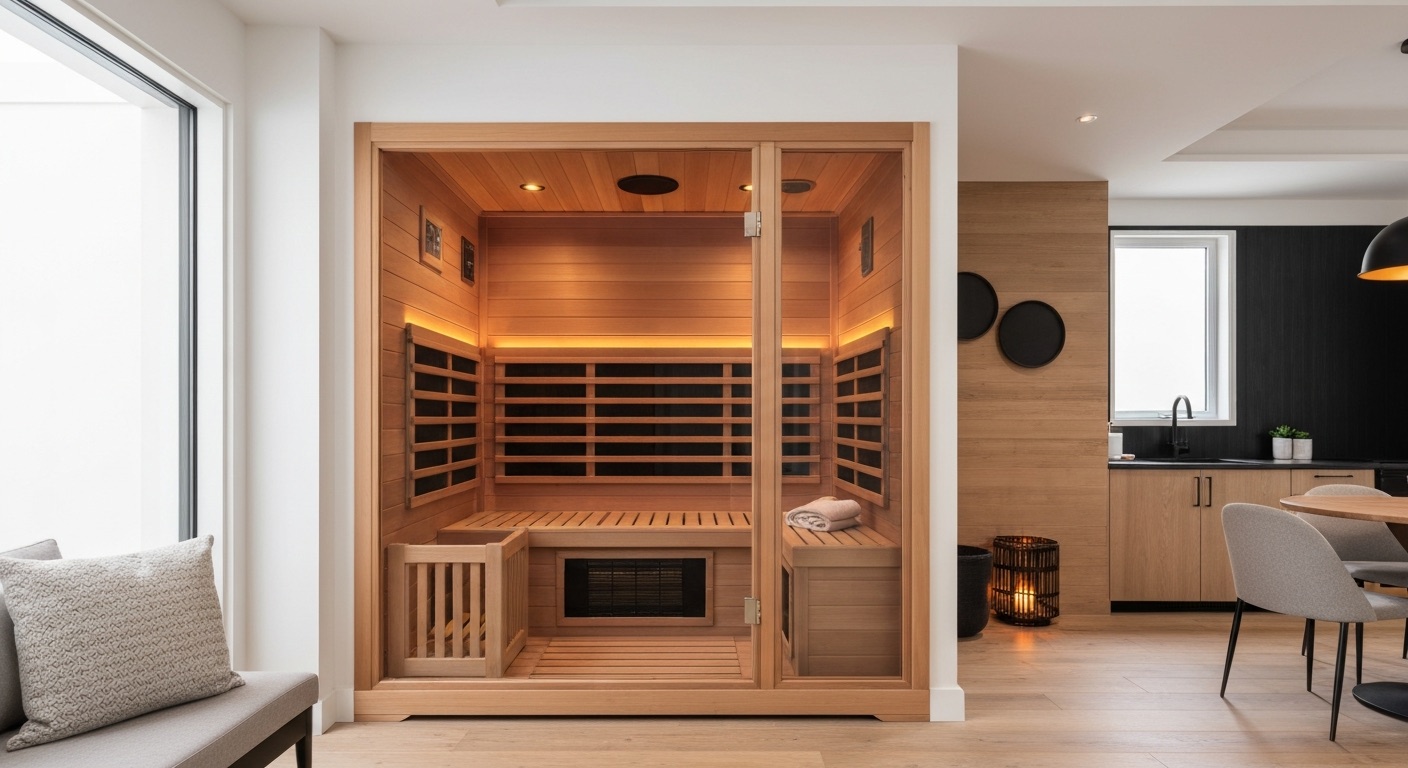
For most indoor infrared saunas the best wood is Canadian hemlock: stable, nearly scent-free and the cheapest of the proper sauna woods. Pick basswood if you want no aroma at all, and western red cedar if you love the smell or the cabin will live outdoors, as long as nobody in the house reacts to cedar. Wood matters less in an infrared cabin than in a Finnish sauna, so rank heaters, build quality and warranty ahead of species.
- 01Infrared cabins run at roughly 45-65 C (113-149 F) with no steam, against about 80 C (176 F) in a traditional sauna, so wood matters less.
- 02By the USDA Wood Handbook numbers, western red cedar is the lightest, most stable and coolest-touching common sauna wood. Hemlock is about 40% denser and 50% harder; basswood moves the most with moisture.
- 03Cedar asthma is documented in sawmill and woodworking dust. For finished saunas the evidence is a few skin allergy cases from Finnish benches; no study covers infrared cabins.
- 04Dynamic, Maxxus Seattle and most JNH models use hemlock. Clearlight offers basswood or mahogany, Health Mate states mahogany and Sunlighten states eucalyptus.
- 05Buy bare, kiln-dried interior wood. An FSC label tells you where the wood came from, not how good or how clean it is.
Does Wood Type Matter in an Infrared Sauna?
It matters less than in a traditional sauna, because an infrared cabin runs cooler and drier and its heat comes from wall panels. In a 2025 University of Oregon lab comparison, the traditional sauna ran at 80 C (176 F) and the far infrared cabin at 45-65 C (113-149 F). Golden Designs gives 118-132 F as the ideal range for its Dynamic Barcelona, and with no water on stones there is no steam. Our infrared vs traditional sauna comparison covers the other differences.
Five things still depend on the wood:
- +Scent and sensitivity: cedar smells strongly and is the only common sauna wood with an allergy literature.
- +Bench comfort: lighter woods conduct less heat and feel cooler on bare skin.
- +Movement: each session dries the wood surface and each cool-down lets it take moisture back.
- +Outdoor durability: only some heartwoods resist decay without a protective shell.
- +Price: cedar is the expensive option and hemlock the budget default.
Why a Heated Cabin Still Works the Wood
By the Wood Handbook's equilibrium tables, wood in a 70 F room at 45% relative humidity settles at about 8.5% moisture content. Heat that same air to 140 F without adding moisture and its relative humidity falls to roughly 6%, and the Handbook puts wood in 140 F air at 5-10% humidity at only 0.9-1.9%. A 30 to 45 minute session cannot dry a whole board that far, but it does dry the surface layer, most of all facing the heater panels. That is why fine surface checks and slightly opened joints near the heaters are normal in any species.
Sauna Woods Compared: The Numbers That Matter
The USDA Forest Products Laboratory's Wood Handbook (2021 edition, FPL-GTR-282) covers every common sauna species except the eucalypts and mahoganies, which brands rarely name botanically. Figures are for clear wood at 12% moisture content, lightest first.
| Wood | Specific gravity | Side hardness (lbf) | Heat conduction (W/m K) | Width change per 1% moisture | Heartwood decay resistance |
|---|---|---|---|---|---|
| Western red cedar Thuja plicata | 0.32 | 350 | 0.10 | 0.234% | Resistant |
| Black cottonwood (poplar) Populus trichocarpa | 0.35 | 350 | 0.10 | 0.304% | Slight or none |
| American basswood Tilia americana | 0.37 | 410 | 0.11 | 0.330% | Slight or none |
| Quaking aspen Populus tremuloides | 0.38 | 350 | 0.12 | 0.234% | Slight or none |
| Yellow-poplar Liriodendron tulipifera | 0.42 | 540 | not listed | 0.289% | Slight or none |
| Western hemlock Tsuga heterophylla | 0.45 | 540 | 0.14 | 0.274% | Slight or none |
Data: Wood Handbook Tables 5-3b (specific gravity, side hardness), 4-7 (thermal conductivity, approximate to about 20%), 13-5 (flat-sawn width change between 6% and 14% moisture) and 14-1 (heartwood decay groups). Side hardness is the force to push a 0.444-inch steel ball halfway into the wood.
Cedar Is the Lightest and Steadiest, Not Basswood
Two seller claims fail these numbers. Basswood is not denser than hemlock (0.37 against 0.45), and it is not the lightest sauna wood either: western red cedar is, at 0.32. Cedar also has the lowest total shrinkage in the group, 6.8% by volume from green to oven-dry against 12.4% for hemlock and 15.8% for basswood.
What the Movement Numbers Mean for a Real Wall Board
Take a typical 3.5-inch-wide flat-sawn wall board that leaves a damp warehouse at 11% moisture content and settles at 6% in your heated room. Using the Handbook's coefficients, it narrows by about 0.058 inch (1.5 mm) in basswood, 0.048 inch (1.2 mm) in hemlock and 0.041 inch (1.0 mm) in cedar. The species gap is a few hundredths of an inch per board; the moisture swing is the bigger lever, so kiln-drying and letting panels sit in the room before assembly matter more than species.
Hardness and How the Bench Feels
Hemlock's side hardness of 540 lbf is about 50% higher than cedar's 350, so it dents less. The trade is heat: hemlock conducts about 40% more heat than cedar (0.14 against 0.10 W/m K), so at the same cabin temperature a hemlock bench feels warmer under bare thighs. At 120-140 F neither gets uncomfortable the way a 176 F Finnish bench can. Traditional sauna builders use very light bench woods for this reason; obeche, a West African hardwood with a green specific gravity of 0.30, is one.
Canadian Hemlock: The Sensible Default
Hemlock is good for an infrared sauna and the most common wood in the category: stable enough, nearly odorless, harder than cedar and the least expensive proper sauna wood. "Canadian hemlock" in sauna listings generally means western hemlock (Tsuga heterophylla), a Pacific coast species the Wood Handbook notes is also sold as British Columbia hemlock.
The Handbook describes the wood as almost white with a purplish tinge, often with small, sound black knots that are usually tight and dimensionally stable. Dark streaks come from bark maggots and do not reduce strength, so neither is a defect. Its weakness is decay resistance, which is slight to none: irrelevant in a dry living room, decisive in a garden. The name also causes needless worry. Hemlock trees are conifers in the pine family and have nothing to do with poison hemlock (Conium maculatum), a weed in the carrot family.
Hemlock is the stated wood for the Dynamic Barcelona, Santiago and Gracia, the Maxxus Seattle, the Golden Designs Reserve Edition and JNH's Ensi, Joyous and Arki.
Western Red Cedar: Aroma, Stability and Outdoor Durability
Cedar is the best wood for an infrared sauna if you want the scent or the cabin will sit outdoors, and the wrong one if anyone in the household reacts to it. Its heartwood resists decay, and it is the lightest, most stable and coolest-touching wood in the table.
It also costs more. On the Golden Designs site, the Maxxus MX-K306-01 three-person cabin listed at $4,999 in hemlock and $6,999 in red cedar in October 2026. The cedar version also gets a touch-screen control panel, so not all of the $2,000 gap is wood, and it is listed 10 lb lighter (310 against 320 lb).
Watch the names. "Canadian red cedar" in listings is western red cedar grown in British Columbia. "Japanese cedar" (sugi, Cryptomeria japonica), which Sun Home uses in its Eclipse, is a different tree, and "Pacific cedar" can mean more than one species, so ask which one you are getting.
Is Cedar Toxic? What the Allergy and Asthma Evidence Covers
Cedar is not toxic in the everyday sense, but it is a known sensitizer, and the best evidence comes from people who breathe its dust for a living.
Sawmill and Woodworking Dust
Western red cedar asthma is the most common form of occupational asthma in the Pacific Northwest and affects 4-13.5% of exposed workers, according to a 1994 review from the University of British Columbia. The cause is plicatic acid, a compound in the wood. It does not always clear: of 232 patients followed up, only 55 of the 136 who left cedar work (40.4%) had fully recovered about four years later. An 11-year study of 243 sawmill workers found a dose-response link between average daily dust levels, from under 0.2 to over 0.4 mg per cubic meter, and faster decline in lung function.
Skin Contact on Sauna Benches
The only sauna-specific evidence is Finnish: Oulu University Hospital dermatologists reported three patients seen in 2012-2014 with allergic contact dermatitis from western red cedar in their saunas, confirmed by patch testing, and described allergy to finished wood as a rarity. Builders face the dust problem with other woods too: two Finnish carpenters developed asthma from obeche dust while building saunas, and recovered once they stopped using it.
What It Means for a Finished Infrared Cabin
No study has looked at asthma from sitting in a finished infrared cabin, and the occupational studies measured sawing and sanding dust, which a finished cabin does not produce. Whether cedar's scent alone can trigger a reaction in someone already sensitized has not been studied. Golden Designs prints a warning on its own cedar models that the wood can irritate eyes, skin and airways and can cause allergic reactions. Sensible rules:
- +Diagnosed cedar asthma or a positive cedar patch test: do not buy cedar, including cedar backrests and bench add-ons for a hemlock cabin.
- +Asthma set off by strong smells, or fragrance sensitivity: choose basswood or hemlock, and if cedar tempts you, sit through a full session in one at a showroom first.
- +A rash where skin meets the bench: sit on a towel and ask a dermatologist about patch testing.
The highest real exposure belongs to whoever cuts and sands the wood. If you plan to build your own infrared sauna, use dust extraction and a respirator rated for fine dust whatever species you choose, and take extra care with cedar.
Basswood: The Scent-Free Choice
Basswood is the best choice if you want an infrared sauna with no wood smell at all. The Wood Handbook describes dry basswood as without odor or taste, soft and light, with a fine, even texture, which is why it also turns up in window blinds.
Its weak points are movement and decay. It has the highest shrinkage and the largest moisture coefficient in the comparison, although the Handbook notes it seldom warps once in use, and its heartwood has little natural decay resistance, so basswood belongs indoors. Clearlight offers it as one of two wood choices on every indoor Sanctuary model, and Sunlighten's US shop lists basswood versions of some Amplify cabins plus basswood backrests.
Poplar, Aspen, Eucalyptus and Mahogany
Poplar and Aspen
"Poplar" on a spec sheet can mean aspen or cottonwood (both Populus) or yellow-poplar, which is not a true poplar but a relative of the magnolia. All three are pale and low in decay resistance, and the Handbook calls well-dried aspen and cottonwood odorless. Aspen moves less than basswood (0.234% per 1% moisture change against 0.330%). In Finland, heat-treated aspen is a common sauna panel and bench wood. JNH uses poplar in its Vivo model.
Eucalyptus
Sunlighten now states eucalyptus for all its saunas, and Sun Home uses it in the Equinox and Solstice. It is a large genus whose woods vary widely: two eucalypts in the Handbook, jarrah and karri, have green specific gravities of 0.67 and 0.82, about double cedar's. Neither brand names the species on its product pages, so ask, and ask whether it is thermally modified.
Mahogany
Health Mate builds its Inspire and Enrich cabins from what it calls 100% Indonesian mahogany, and Clearlight offers mahogany as the alternative to basswood across the Sanctuary line. "Mahogany" is a trade name: the Handbook's true mahogany (Swietenia macrophylla) is in its decay-resistant group, while African mahogany (Khaya) is rated moderately resistant, and neither brand gives a botanical name. Indoors, you are paying mostly for the darker look.
Which Wood Does Each Brand Use?
The table lists what each manufacturer states on its own product pages as of October 2026. Golden Designs makes Dynamic, Maxxus and its own line. Brands change species, so check the exact model's spec sheet.
| Brand and model | Wood, as the maker states it | Checked on |
|---|---|---|
| Dynamic Barcelona, Santiago, Gracia | Natural reforested Canadian hemlock | goldendesigninc.com |
| Maxxus Seattle | Natural reforested Canadian hemlock | goldendesigninc.com |
| Maxxus K-series (MX-K306, K356, K406), Montilemar, Avignon | Natural reforested Canadian red cedar (some also sold in hemlock) | goldendesigninc.com |
| Golden Designs outdoor hybrids | Hemlock with a waterproof exterior stain, or an all-weather exterior with a Canadian red cedar interior | goldendesigninc.com |
| JNH Ensi, Joyous, Arki | FSC-certified Canadian hemlock | jnhlifestyles.com |
| JNH Tosi | Canadian hemlock or Canadian red cedar | jnhlifestyles.com |
| JNH Vivo | Poplar | jnhlifestyles.com |
| Clearlight Sanctuary 1, 2, 3, 5 | Mahogany or basswood, buyer chooses | infraredsauna.com |
| Sunlighten mPulse | Eucalyptus (stated for all Sunlighten saunas; no per-model wood line) | sunlighten.com |
| Health Mate Inspire, Enrich | 100% Indonesian mahogany | healthmatesauna.com |
| Sun Home Equinox, Solstice | Kiln-dried eucalyptus | sunhomesaunas.com |
| Sun Home Eclipse | Japanese cedar | sunhomesaunas.com |
Hemlock dominates the plug-in cabins under $5,000, and none of the premium brands here (Clearlight, Sunlighten, Health Mate) lists cedar on the models checked.
How to Judge Wood Quality Before You Buy
Grade and Knots
Clear grade means few or no knots; knotty grades are cheaper and fine if the knots are tight. Reject loose or cracked knots on benches and backrests, and large knots right in front of a heater panel. Resinous pine and spruce can weep sticky pitch when warmed, one reason infrared makers avoid them.
Kiln-Dried, at the Right Moisture Content
Ask for kiln-dried wood and its moisture content. The Handbook recommends interior woodwork at about 8% on average for most of the United States (6-10% for individual pieces), 6% in the dry Southwest and 11% in damp, warm coastal areas, and its basic rule is to install wood at the moisture content it will live at. So unbox the panels in the room where the sauna will stand, not in a cold garage.
Bare Wood Inside, Finish Outside Only
The interior should be bare, untreated wood. Bare wood takes up sweat and gives it back as the cabin airs out; a film finish traps moisture, can turn tacky at sauna temperatures and adds its own chemicals to the air you breathe. Health Mate's care advice says the same: avoid interior treatments. Exteriors are different: Golden Designs puts a waterproof stain on the outside of its outdoor hemlock cabins and leaves the inside natural. Glued bench laminates and panel adhesives are the other source of new-sauna smell, which our guide to infrared sauna off-gassing covers in detail.
What FSC Certification Does and Does Not Tell You
FSC certification is about origin, not performance. An FSC label means the wood came from FSC-certified forests (FSC 100%), from a mix of certified, recycled and controlled sources (FSC Mix), or from recycled material (FSC Recycled), and that it met chain-of-custody requirements at every step of the supply chain. It says nothing about grade, stability, emissions or allergy, and "reforested" or "eco-certified" are not FSC claims without a certificate code.
Which species, by botanical name? Kiln-dried to what moisture content? Is the interior unfinished? Solid or glued-laminate benches? Is there an FSC certificate code?
Outdoor Saunas: Where Species Really Matters
Outdoors, decay resistance stops being academic. The Handbook expects exterior wood to sit near 12% moisture content (9-14% for individual pieces) against about 8% indoors, rain and humidity push it higher, and above ground only the heartwood of resistant species such as western red cedar copes without help. Hemlock, basswood and aspen are all slightly or nonresistant, and untreated sapwood of essentially every species has a short life in damp conditions.
So outdoor cabins either use cedar or shield a less durable wood. Golden Designs stains the exterior of its outdoor hemlock models, Clearlight puts a DriftwoodTec finish on the outside of the Sanctuary Outdoor with mahogany inside, and Sun Home wraps a cedar interior in aluminum on the Luminar. Our best outdoor infrared saunas roundup compares cabins built for year-round weather, and the guide to how long infrared saunas last covers the lifespan of each part.
Caring for Each Wood
The routine is the same for every species: a towel on the bench, a wipe-down after each session, the door left open so the wood dries, and no oil or sealer inside. Pale woods such as hemlock and basswood show sweat marks sooner; a light sanding with fine paper removes them, and with cedar do that sanding with a dust mask on. Products, steps and frequency are in our infrared sauna cleaning guide.
The Best Wood for Your Situation
Match the wood to the room and the people using it, then focus on heaters, EMF data and warranty.
| Your situation | Best wood | Why |
|---|---|---|
| Indoor cabin, no sensitivities, best value | Canadian hemlock | Stable, harder than cedar, nearly odorless, the cheapest proper sauna wood |
| Fragrance sensitivity or asthma set off by smells | Basswood, with hemlock a close second | No odor when dry and no allergy literature to speak of |
| You want the classic sauna smell | Western red cedar | Aromatic, lightest, most stable, coolest bench |
| Outdoor cabin | Cedar heartwood, or any wood behind a weatherproof shell | Only decay-resistant heartwood copes with weather unprotected |
| Diagnosed cedar asthma or a positive cedar patch test | Anything except cedar | Includes cedar backrests and bench add-ons in a hemlock cabin |
| Premium build where the look matters most | Mahogany or eucalyptus, after asking the species | You are paying mostly for appearance |
FAQ
Is cedar toxic in an infrared sauna?+
Is hemlock good for an infrared sauna?+
Hemlock vs cedar: which is better for an infrared sauna?+
Is basswood better than cedar for allergies?+
Should I stain or seal the inside of an infrared sauna?+
- Wood Handbook: Wood as an Engineering Material (FPL-GTR-282). USDA Forest Service, Forest Products Laboratory, 2021.
- Comparison of thermoregulatory, cardiovascular, and immune responses to different passive heat therapy modalities. American Journal of Physiology - Regulatory, Integrative and Comparative Physiology, 2025.
- Mechanism of occupational asthma due to western red cedar (Thuja plicata). American Journal of Industrial Medicine, 1994.
- Follow-up study of 232 patients with occupational asthma caused by western red cedar (Thuja plicata). Journal of Allergy and Clinical Immunology, 1987.
- Western red cedar dust exposure and lung function: a dose-response relationship. American Journal of Respiratory and Critical Care Medicine, 1996.
- Contact allergy to finished woods in furniture and furnishings: a small allergic contact dermatitis epidemic to western red cedar in sauna interior decoration. Journal of the European Academy of Dermatology and Venereology, 2016.
- Sauna builder's asthma caused by obeche (Triplochiton scleroxylon) dust. Thorax, 1994.
- What the FSC Labels Mean. Forest Stewardship Council.
We do not run a test lab. Figures on this page come from the sources above, from published manufacturer specifications, or are reasoned estimates that are labelled as such.