Premium Full-Spectrum Infrared Sauna
Sunlighten mPulse Review: The Most Technologically Advanced Consumer Infrared Sauna
Verdict: the Sunlighten mPulse Smart Sauna is the most technically capable infrared cabin you can buy for a home, and the only one that lets you set the ratio of near, mid and far infrared per session. As of mid-2026 it typically lands in a band of roughly $7,000 for the 1-person Aspire up to $13,000 and above for the 4-person Empower, quoted through a Sunlighten consultation rather than a shelf price. It suits a buyer who will use it several times a week for a decade and who wants documented low EMF plus wavelength control; anyone who just wants a hot cabin that sweats is paying two to four times too much.
Category scores
Our take
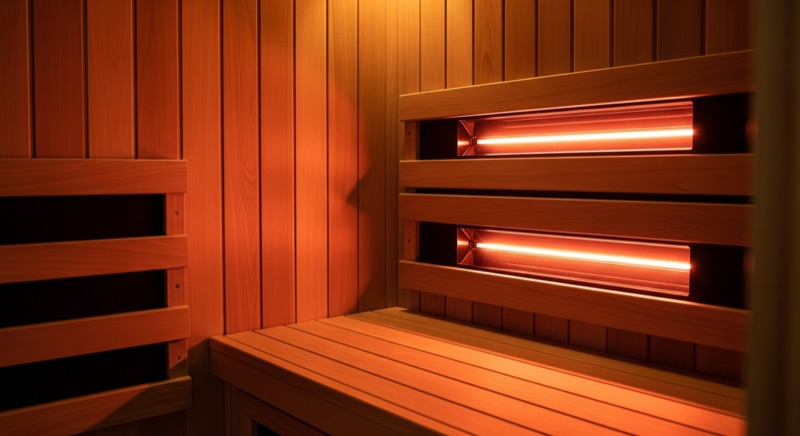
Most infrared sauna brands sell a simple proposition: carbon panels, a wood box, a thermostat. Sunlighten sells something different. The mPulse's SoloCarbon heater system delivers near infrared (700-1400nm), mid infrared (1400-3000nm), and far infrared (3000nm-1mm) at independently programmable ratios. No other consumer sauna does this. The PulseIQ app manages preset protocols - sleep, recovery, cardiovascular, anti-aging - that blend wavelength ratios based on Sunlighten's internal research and published clinical literature.
Whether the clinical significance of different wavelength ratios justifies a $9,000-12,000 price tag is a question every potential buyer must answer for themselves. The honest position: the SoloCarbon heater is a genuine technological innovation, not marketing vocabulary applied to a commodity panel. The programmable wavelength protocols are based on real research (near infrared has different tissue penetration characteristics than far infrared; the distinction matters for different therapeutic goals). The price premium is real, and so is the technology.
Sunlighten has an active relationship with UCSF for clinical research on infrared sauna. They are not a brand that avoids scientific scrutiny - they invite it. That is a meaningful signal for buyers who want evidence-based justification for the premium.
The direct-only purchase model means no Amazon, no dealer, and 6-10 week lead time. For buyers accustomed to two-day shipping, this requires planning. For buyers serious about a $9,000+ purchase, the lead time is not the primary concern.
Sunlighten mPulse price: what each size actually costs
Sunlighten does not run a normal add-to-cart checkout for the mPulse. You submit an enquiry, a consultant contacts you, and you receive a quote built around your model, your upgrades and your delivery address. That is why searching for mPulse pricing returns such a wide spread of figures: people are reporting individual quotes, not a fixed list price, and those quotes move with seasonal promotions, freight distance and whichever upgrades were bundled in. The bands below are what buyers were typically seeing as of mid-2026. Use them for budgeting, then confirm the current number with Sunlighten before you commit, because a promotion can shift a quote by four figures.
Indicative bands observed mid-2026, not quoted prices. Sunlighten sells by consultation; verify current pricing with the manufacturer.
The pattern across the line works out to roughly $1,500 to $2,500 for each additional person of capacity. That makes the Believe to Conquer step the strongest value move in the range if your room can take it, because a third seat costs about the same as one or two accessory upgrades. Going the other way, the 1-person Aspire is the only mPulse that competes on price with a well-specified mid-market two-person cabin, and it does so by giving up capacity rather than technology.
What the quote includes, and what is added on top
- +Cabin, bench, glass door and interior lighting
- +The full set of SoloCarbon full-spectrum heaters for that model
- +Smart control panel and app pairing
- +Standard basswood construction
- +Warranty, with lifetime coverage claimed on the heaters
- +Curbside freight within the continental US on most orders
- -Room-of-choice delivery, stair carries and pallet disposal
- -Electrical work: a dedicated circuit, and a 240V line on the larger models
- -Cedar in place of standard basswood
- -Halotherapy salt generator and upgraded audio
- -Acoustic resonance and other therapy add-ons where offered
- -Sales tax, and any assembly service if you do not want to build it
The line items that surprise buyers are the boring ones. Freight arrives curbside on a pallet by default, and a two-person 400-pound crate does not walk itself down a basement stair. Electrical is the other one: smaller models run on a standard household circuit, but the larger cabins want a dedicated line and often 240V, which means an electrician quote of a few hundred dollars before the sauna is usable. Budget one to two thousand dollars on top of the cabin price for delivery and electrical unless your quote explicitly covers both.
On relative price, the mPulse sits at the top of the market. A comparably sized Clearlight Sanctuary generally quotes a couple of thousand dollars less and comes with more detailed third-party EMF documentation, but no wavelength programming. A mid-market full-spectrum cabin from the brands covered in our best full-spectrum infrared sauna guide runs $2,500 to $4,500 and gets you near infrared plus far infrared without independent control of either. In blunt terms you are paying three to four times a mid-market price for programmability, verified body-position EMF, and a support relationship with the manufacturer rather than a marketplace seller.
The SoloCarbon heater: what it actually does
SoloCarbon is Sunlighten's patented heater technology. The claimed emissivity is 96% at 9.4 microns - the wavelength that corresponds to peak absorption by water molecules in human tissue. Most carbon heaters emit across a broad spectrum; SoloCarbon's design concentrates output at the optimal absorption wavelength for far infrared therapy.
The more important innovation in the mPulse is the NIR/MIR/FIR independence. Near infrared penetrates tissue more deeply (2-7cm) and is associated with cellular energy production and photobiomodulation effects. Mid infrared penetrates less deeply and is associated with circulation and musculoskeletal effects. Far infrared penetrates 1-2cm and is associated with core temperature elevation, detoxification, and cardiovascular effects. In a standard sauna, all three are present but at fixed ratios determined by heater element and temperature. In the mPulse, each can be adjusted independently.
In practice, the PulseIQ app's preset protocols save most users from manually setting wavelength ratios. You choose "Sleep" or "Recovery" or "Cardio" and the system configures the appropriate wavelength blend. The protocols are based on Sunlighten's published research. For buyers who want to go deeper, manual wavelength control is available.
This is not a feature you get anywhere else at any price in consumer saunas. If you want programmable full-spectrum infrared therapy, Sunlighten is the only vendor.
EMF: verified, not just claimed
Sunlighten publishes EMF readings of under 0.5-2.0 mG at seated body position. The methodology matters: this is measured where your body actually sits, not at the heater panel face. The distinction from budget brands (which measure at the panel) is significant - panel-face readings of "under 8 mG" on budget units may correspond to 2-5 mG at body position, while Sunlighten's verified figure is already at body position.
For comparison: a standard office environment with computer equipment typically reads 1-4 mG. Sunlighten's seated EMF is in that same range or lower, inside an active infrared sauna. For EMF-sensitive buyers, this verification matters.
Where Sunlighten's EMF documentation differs from Clearlight: Clearlight uses Vitatech third-party testing and claims virtually zero mG (rather than "under 0.5-2.0 mG"). Clearlight also shields electric field (ELF) in addition to electromagnetic field (EMF), which covers more of the picture. For buyers who want the absolute lowest verified EMF with the most complete shielding, Clearlight Sanctuary is the choice. For buyers who want ultra-low EMF plus programmable wavelengths and app integration, Sunlighten is the choice. There is no product that combines both.
Both are ultra-low EMF in practical terms. The difference between virtually zero and under 2 mG is clinically insignificant for most users.
Build quality
The mPulse cabin is basswood on standard configurations. Basswood is a premium wood - stable, light, and sustainably sourced. It does not have cedar's distinctive aroma, and some buyers specifically want cedar for the sensory experience. Cedar is available as an option on some Sunlighten configurations at additional cost.
The interior finish quality is consistent with the price point. Panel joints are tight, the glass door seals cleanly, and the bench is ergonomically designed for the extended sessions (30-45 minutes) that the PulseIQ protocols target. The touchscreen control panel is responsive and integrated cleanly with the PulseIQ app via Bluetooth.
The Believe (2-person) at approximately 56"W x 45"D provides genuine 2-person space - not the optimistic 2-person labeling of budget units. Two average adults can use it simultaneously with comfortable personal space. The Conquer (3-person) extends this further.
The warranty covers heaters for life. Cabinet warranty terms vary by model - confirm at purchase. Sunlighten's direct model means support goes through the brand rather than a dealer network, which simplifies the service chain for warranty claims.
Value assessment
The Sunlighten Aspire (1-person) starts at $6,500-7,000. The Believe (2-person) runs $8,999-10,000. The Conquer (3-person) reaches $10,299-12,099. These are significant sums. The value question is whether what you get for $6,000-10,000 more than a Maxxus Seattle ($2,000-2,300) justifies the premium.
What the premium buys: programmable NIR/MIR/FIR wavelengths (unique to Sunlighten in consumer saunas), verified ultra-low EMF at body position, PulseIQ app with evidence-based session protocols, lifetime heater warranty, direct brand support, and a build quality substantially above mid-market units. For buyers who will use the sauna daily for years and for whom the wavelength programming and EMF verification matter, these are real benefits.
For buyers who want a functional sauna that gets hot and does not cost $10,000, the Maxxus Seattle at $2,000-2,300 or the Clearlight Sanctuary 2 at $7,399 are the alternatives to consider. Clearlight is $1,500-2,600 less than comparable Sunlighten models and delivers ultra-low EMF with better third-party documentation. What Clearlight does not offer: programmable wavelength ratios and the PulseIQ app system.
The 6-10 week lead time is the practical friction point. Budget accordingly if you have a target date for installation.
Pros and cons
Who should buy this - and who should not
- +Programmable wavelength protocols (NIR/MIR/FIR control) are a priority - nothing else offers this
- +Budget is $9,000-12,000 and you want the most technologically advanced consumer sauna available
- +The PulseIQ app and evidence-based session programming align with how you approach health optimization
- +Ultra-low EMF with published body-position verification is required
- +You plan daily use for 10+ years and want the best long-term investment
- -Budget is under $9,000 - the Clearlight Sanctuary 2 at $7,399 is the correct premium alternative
- -The absolute lowest documented EMF with third-party ELF shielding is required - Clearlight wins that comparison
- -You prefer cedar over basswood and aromatics matter to your sauna experience
- -You need the sauna within 4-6 weeks - the 6-10 week lead time rules Sunlighten out for near-term needs
- -Amazon purchase process and return protection are important to you
Frequently asked questions
What makes Sunlighten SoloCarbon different from standard carbon heaters?+
How does Sunlighten EMF compare to Clearlight?+
What is the lead time and where can you buy the Sunlighten mPulse?+
How much does a Sunlighten mPulse cost?+
Is the Sunlighten mPulse worth it?+
What is the difference between the Sunlighten mPulse and the Signature?+
Sunlighten mPulse - Direct Purchase Only
Sunlighten sells direct with no dealer markup variability. Note the 6-10 week lead time when planning your purchase. No Amazon or retail availability.
View mPulse at Sunlighten.com